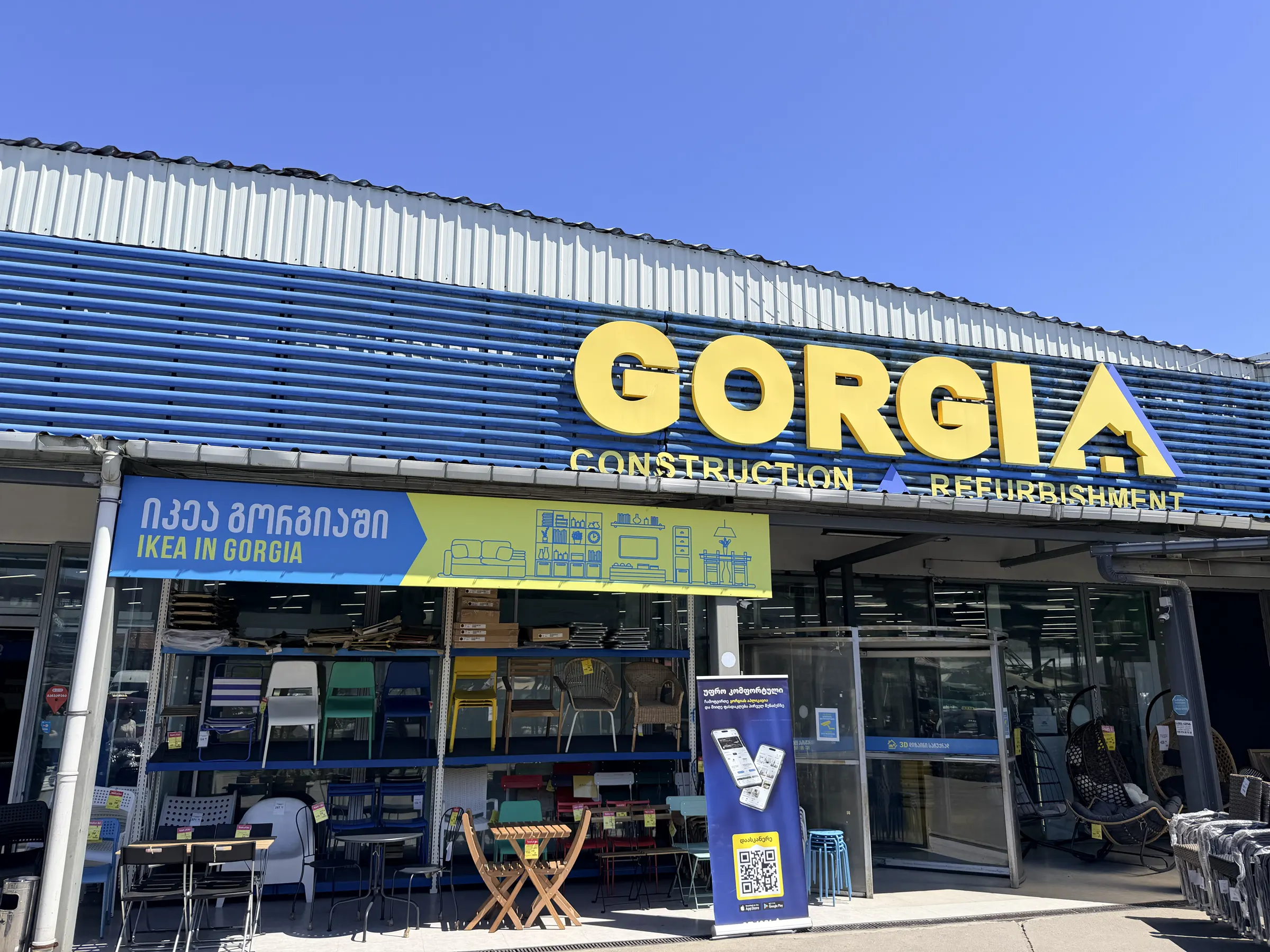

The building-materials market in Batumi rests on three big players — Modus, Gorgia and Nova. Consumables and general items are fastest to close at Gorgia, electrics at Sakcable next door to Modus, tile and wallpaper at Jaokeni, Knauf drywall at Luka, plumbing at Aqaroom (mid-range, includes Grohe) or Vitra (premium). If something you need isn't in town, we usually bring it in from Tbilisi via Domino — that takes about a week. On materials, budget +7% on top of the estimate for surprises.
A map of the building-materials market in Batumi
The building-materials market in Batumi is three pillars and a dozen niche shops around them. Modus, Gorgia and Nova hold roughly 60% of day-to-day supply for projects: any renovation in the city touches these three points one way or another.
Modus and Gorgia are general builders' merchants: that's where you go for consumables, small items and basic positions. Nova occupies a similar niche. Around them are the niche specialists: Sakcable for electrics, Jaokeni for tile and wallpaper, Luka for Knauf products, Aqaroom and Vitra for plumbing.
The logic is simple: first you decide on the material category, then the shop for it. General items — Gorgia or Modus. Electrics — Sakcable. Tile and wallpaper — Jaokeni. Plumbing — Aqaroom or Vitra by segment. Knauf drywall — Luka. Not in Batumi — bring it in from Tbilisi via Domino. Truly rare and time is tight — the small shops on Pushkin Street next to the big builders' merchants. We've made a small map of all the shops and warehouses for ourselves to make navigation easier.
What to buy where in Batumi
Consumables and general items — Gorgia
Gorgia is the workhorse of any renovation. They sell every kind of consumable: from polypropylene pipes for water runs to mineral wool, from fasteners to curtain rails. If the question is "where can I quickly buy another pack of something," the answer is almost always — Gorgia.
The main convenience is that one trip closes a long list of mixed items. The plumber asked for polypropylene — got it. Insulation — got it. Curtain rails — got it. That removes the "send the site supervisor to five shops for ten items" problem: one trip, one receipt, one transport.
If instead of one trip to Gorgia you make five separate runs, you lose hours and money — petrol, cargo taxi, crew downtime. The basic principle: Gorgia is shop number one for the bulk of materials, and after that come targeted runs to the specialised stores for what wasn't in stock or for the right brand. No general-purpose place will close a hundred percent of the items, but as point one, Gorgia works without fail.
Electrics — Sakcable next door to Modus
The most convenient place to buy electrics is Sakcable — a niche electrical shop: wires, cables, breakers, panels, fittings. It's literally across the street from Modus, which gives a useful pairing: one trip — two shops.
An electrician on site has both general construction needs (chases, back boxes, junction boxes, small fasteners) and strictly electrical ones (cable of a specific cross-section, breakers of a specific rating). Modus covers the first part, Sakcable the second. "Across the street" really means across the street: you can walk, no need to move the car. One purchase cycle saves half a day.
If you're doing the renovation yourself and aren't very fluent with electrics, you can come into Sakcable with a list from your electrician and assemble the order by the list. The shop is a niche specialist — they know how to talk in cable cross-sections, colour coding and breaker ratings. That's its strength.
Tile and wallpaper — Jaokeni
For tile and wallpaper it makes sense to go to Jaokeni. A shop with a good selection in both categories, and for the finishing stage it closes most of the tasks.
Tile is something you almost always pick visually, by sample, texture, colour. Buying it sight unseen is risky (we don't recommend doing that — you'll be disappointed): the same article looks very different on screen and in person. So in Batumi, a shop with a large assortment where you can come in and look around is a serious advantage. Jaokeni is exactly that kind of place: people go there to look, hold it up, choose.
Wallpaper is a similar category. You want to see the texture, understand how the light falls on it, judge the weight. Jaokeni also has a good selection of wallpaper; for most residential renovation projects in Batumi, that range is more than enough. It's convenient that tile and wallpaper close at one point. When planning finishing estimates, it makes sense to put a visit to Jaokeni into the route as a mandatory stop.
Knauf drywall — Luka
Knauf products — drywall, profiles, related accessories — are sold at Luka. At the stage of installing partitions, ceilings, niches, boxes, levelling walls with drywall — you go here.
Knauf is a brand with established quality, and many projects are written for it from the start. A specific profile type, a specific thickness of drywall, moisture-resistant or standard — all of this can be selected purposefully at Luka, not at random.
The link is simple: the designer or the site supervisor compiles a list of Knauf items for the project — sheets of a certain type, profiles in the required quantity, fasteners, Knauf filling compounds. The full list closes at Luka. If the project is large and Knauf materials are needed in significant volumes, it makes sense to call or drop in ahead of time and check stock for the required quantities: small volumes are almost always there, larger ones sometimes need a delivery or a reservation.
Plumbing: Aqaroom and Vitra
Plumbing in Batumi splits by segment:
- Aqaroom — the mid-range. A good selection of basins and Grohe plumbing. A working option for most residential projects of mid-level quality — to assemble a plumbing kit for a property without an excessive budget and without compromises on the assemblies' quality.
- Vitra — the premium segment. You go here when the visual and functional bar is set above the average: expensive hotels, premium apartments, projects with a high level of finish.
At Aqaroom, the Grohe assortment is especially worth attention. If the client's project specifies Grohe — mixers, shower systems, fittings — Aqaroom will close most of the items. That matters: Grohe isn't sold everywhere in Georgia in normal volumes, and in Batumi Aqaroom is the place where you can actually look at it. Basins are a separate plus: an item you also want to see in person — fit it to the countertop, check the dimensions.
Vitra is a different story. You go there with the understanding that the budget allows for premium, and the task is to find specific models in this segment. For projects where different fixtures may be in different segments (the guest bathroom — mid-range, the master bathroom — premium), simply visit both points and assemble a combined kit.
Logistics and delivery
Delivery from other cities and Domino
A super-important observation is that not all builders' merchants in Georgia have branches in Batumi. Some chains are present only in Tbilisi and have nothing of their own in Batumi. This is especially relevant for individual plumbing items — there are models that simply aren't in any shop in town.
In such cases, Domino works — they handle delivery from other cities to Batumi. Domino has a very convenient website where you can find shower cabins, laminate, water filters, range hoods — and right on the site you can arrange door-to-door delivery to your apartment.
On timing. If the material is in stock in Tbilisi, delivery usually takes about a week. The delivery from Tbilisi to Batumi at the major suppliers runs on a schedule — usually on Tuesday or Wednesday. Order on Thursday — the truck goes the next Tuesday, real lead time closer to 5–7 days. Order on Monday — it can arrive that same Wednesday. The direct consequence: when planning work stages, look at the day of the week and account for the Tbilisi–Batumi rhythm.
Modus's warehouse and navigation in Google Maps
Modus and Gorgia are shops that usually have stock at the warehouse. That's an important advantage: you don't wait a week for delivery, you go and pick the material up straight from the warehouse.
But Modus has a quirk. The warehouse isn't next to the shop — it's on the outskirts of Batumi, and Google Maps has the wrong pin on it. If you go "by the point on the map," you'll arrive in the wrong place, lose time, and at worst miss the delivery window. The rule is simple: drive strictly by the geolocation given by the shop or the manager, not by what Google Maps shows.
In practice: when they tell you "the warehouse is here," take the coordinates from Modus — a geolocation message in the messenger or a link from the manager — and drive by those coordinates. On the map everything looks logical, but the actual entrance can be off to the side. If you're going for the first time, budget an extra 20 minutes for "finding it" and call the shop before leaving — that removes 90% of the risk of arriving in the wrong place.
Cargo taxi for 20–30 GEL
A useful Batumi life hack: at all the major warehouses and builders' merchants, small cargo taxis are on duty — private drivers with pickups or minivans who take orders on the spot.
The cost of delivery to a property within the city is typically 20–30 GEL (per trip). A negligible sum compared to the cost of the materials and the crew's time. For that money, the cargo is delivered to the address — without your time, without a site supervisor's resource and without the petrol of your personal car. Especially relevant for oversized lots: drywall sheets, rolls of insulation, boxes of tile. Hauling that in a passenger car's boot is more expensive in the long run, and five trips will eat half a day.
For crews this is a standard part of logistics: there are already arrangements with the drivers — who takes how much, who loads more carefully, who arrives in a hurry. If you're doing the renovation yourself, work with the drivers standing by the warehouse: prices are roughly the same, you can haggle within 20–30 GEL, but there's no real point in saving heavily here.
Rare and non-standard items
Small shops on Pushkin Street
Sometimes an item just isn't in the big shops: a specific ventilation duct, a non-standard fitting, an unusual fastener. Modus, Gorgia, Nova checked — nothing. The niche specialists don't have it either.
In this case, a trick the locals know works: the small builders' shops on Pushkin Street. They're located next to the big builders' merchants and often close the "gaps" — items that the big chains don't carry because it's not profitable for them to keep rare articles.
These small shops are points with fast turnover under local demand. There you can find exactly the ventilation duct you've been searching for in three big shops without success. The advantage is being right next to the big players: there's no need to plan a special trip. You came to Modus or Gorgia anyway, didn't find it — and immediately walk through the neighbouring small points. 15–30 minutes, and that's often enough to close a rare item without launching delivery from Tbilisi via Domino. Keep Pushkin Street in mind as your "Plan B" for non-standard items.
Ordering from Ozon and Wildberries: when it's worth it
For people doing the renovation themselves who have hit a wall on a rare item, there's another option — Ozon or Wildberries. A workable option, but with significant caveats.
First — customs. An order from Russia to Georgia goes through customs clearance, and there can be problems there. Not a disaster, but a risk: the parcel may get stuck, clearance can take time, additional costs may come up. For urgent items this is especially unpleasant: the crew is waiting, the site is idle.
Second — weight. International delivery is priced by weight, and that changes the entire economics of the order significantly. Light hardware, small items, a specific tool weighing up to a couple of kilograms — the delivery price is acceptable, and then the Ozon/Wildberries route really is worthwhile. But as soon as the weight grows, the delivery price grows manifold. Ordering 15 kg of waterproofing this way is pointless: weight-based shipping will turn a low material price into a high final bill. Waterproofing, cement mixes, liquids and rolls — only locally in Batumi.
Always stick to a simple rule: Ozon and Wildberries are for light, rare items that objectively aren't in Georgia. For example, a sealant of a specific colour that isn't here in Batumi. And this option is primarily for self-managed renovations. If you're working with a good contractor (a crew), they'll close a rare item through their suppliers without diving into customs risks.
Budget and price comparison
How to compare prices and budget the buffer
The financial side of purchasing rests on two principles.
First: comparing prices across the key players is done at the start of each new work stage, not once at the start of the project for everything. Prices here change constantly, deliveries arrive unevenly, the GEL/USD rate drifts. Lock in prices at the start of a project and plan against them for six months — and you almost certainly won't fit the estimate.
The right way is to go stage by stage. Electrics begins — make a round of Sakcable. Finishing — Jaokeni for tile and wallpaper. Plumbing — Aqaroom, Vitra. At each stage, a fresh "snapshot" of prices is taken, and the purchase plan is adjusted to current numbers (and discounts often appear that it would be a sin not to use). A small life hack: you see that the bath you're definitely going to buy at this shop because no one else has it has gone on sale and is now selling at a thousand-GEL discount — buy it.
If the renovation is organised by a contractor, the materials estimate is given upfront, based on the project. That is the estimate. And here the second principle kicks in.
Second: always budget +7% on top of the calculated material volume for surprises. This isn't "margin," it's a reality buffer. What goes into it:
- tile breakage during installation (the standard waste percentage);
- measurement errors and re-cutting to actual dimensions;
- extra items that surface when walls or floors are opened up;
- consumables that get used up faster than they look on paper;
- small bits that get forgotten at the estimate stage;
- price jumps between stages.
Seven percent is an empirical figure, calibrated across many projects of our Level Up crew. Less — you're constantly going into the client's pocket, or your own, for "unforeseen" items. More — you overload the estimate and lose competitiveness at the start of the deal. Stage-by-stage price comparison gives accurate numbers in the moment; the +7% buffer covers what truly cannot be calculated. Together — a predictable renovation budget without surprises at the finish.
Summary table: what to buy where
| What you need | Shop |
|---|---|
| Consumables, mineral wool, polypropylene pipes, curtain rails | Gorgia |
| Electrics: wires, cable, fittings for wiring | Sakcable (across the street from Modus) |
| Tile, wallpaper | Jaokeni |
| Knauf drywall, profiles | Luka |
| Mid-range plumbing, basins, Grohe | Aqaroom |
| Premium-segment plumbing | Vitra |
| Delivery from Tbilisi for rare items | Domino (delivery usually Tue–Wed, ~one week) |
| General builders' merchant with stock at the warehouse | Modus, Gorgia, Nova |
| Rare items (e.g. a ventilation duct) — Plan B | Small shops on Pushkin Street |
| Delivery from warehouse to property | Cargo taxi at the warehouse (20–30 GEL) |
| Light, rare items for self-managed renovations | Ozon / Wildberries (allowing for customs and weight) |
FAQ
Takeaways
- The Batumi building-materials market rests on three big players — Modus, Gorgia and Nova; around them work niche specialists in electrics, tile, drywall and plumbing.
- Consumables and general items (polypropylene pipes, mineral wool, curtain rails) are most convenient to close at Gorgia in one trip.
- Electrics are best bought at Sakcable — across the street from Modus, which gives an "electrics + general construction" combination in one trip.
- Tile and wallpaper — Jaokeni; Knauf drywall and profiles — Luka; mid-range plumbing and Grohe — Aqaroom; premium — Vitra.
- If something isn't in Batumi, it's brought in from Tbilisi via Domino; lead time about a week, delivery on Tuesday/Wednesday.
- Modus's warehouse is on the outskirts, the Google Maps pin is wrong — drive only by the geolocation from the manager.
- Cargo taxis at the warehouses close delivery to the property for 20–30 GEL; small shops on Pushkin Street are Plan B for rare items.
- Ozon and Wildberries are justified only for light, rare items in self-managed renovations; on heavy materials, weight-based pricing makes the order unprofitable.
- Compare prices again at the start of each new stage; on materials budget +7% buffer over the estimate — that covers surprises without overrunning.