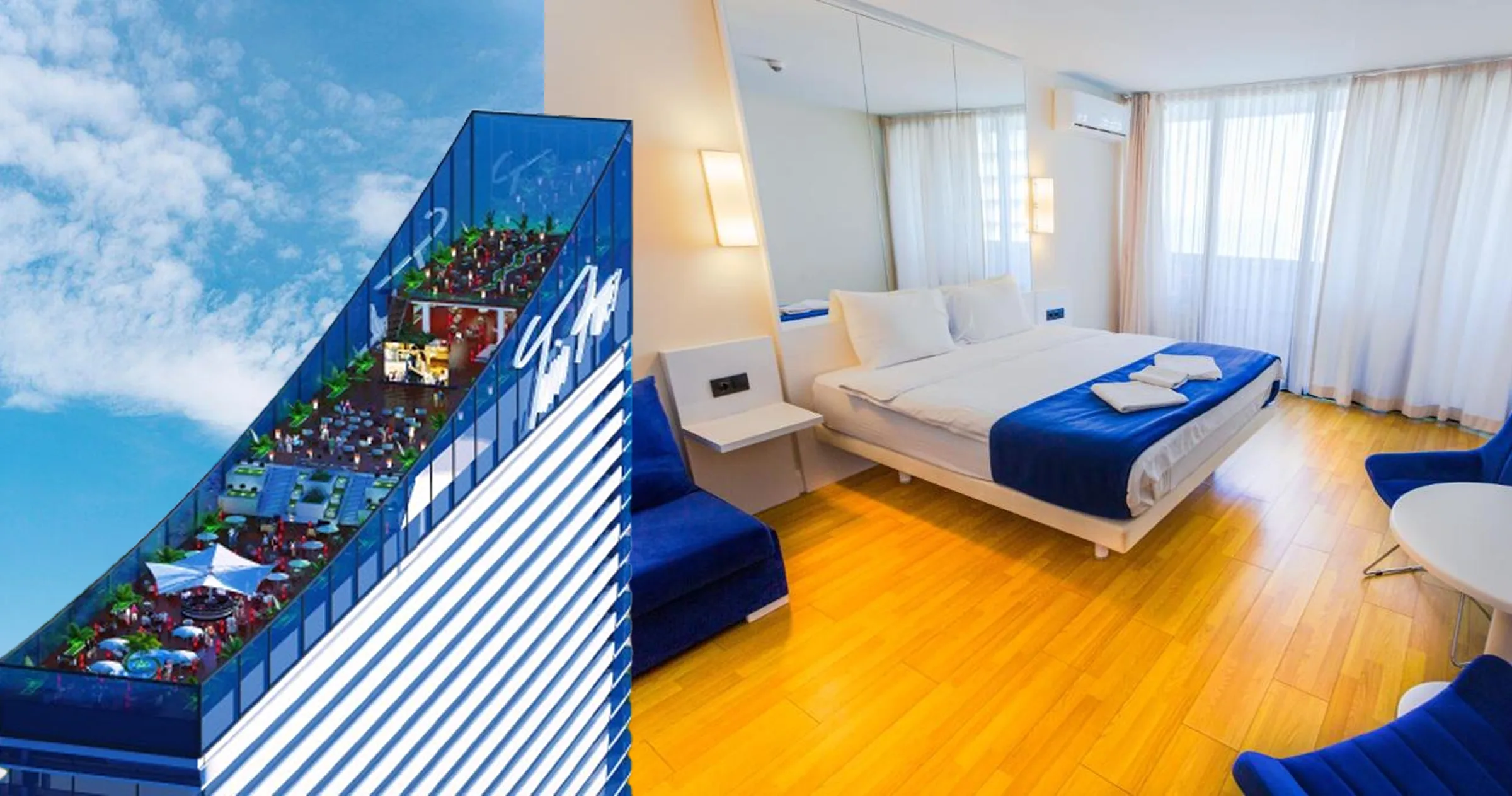

A renovation for rental isn't a designer project and isn't "as if for yourself." It's a business: cut costs, stabilise income. Wear-resistant materials handle traffic, surfaces wash between check-ins, nothing fragile. Money goes into lighting, an accent wall for photos, the mattress, blackout curtains and plumbing. Air conditioning is mandatory — without it, the rating will be poor even with a perfect apartment. Renovate in winter, in low season.
The logic of a rental renovation
Short-term rental is a business
The first thing the Level Up site supervisor tells an owner of an Airbnb or Booking apartment: stop thinking of it as your beloved baby. Rental is a business, not your dream apartment. A business has two tasks: cut costs, increase income.
Costs. Plan a renovation that won't need to be redone in a year. Without replacing the wallpaper after the first summer and without a plumber every three weeks. Cleaning takes forty minutes, not two hours. Every decision in the renovation either zeroes out an ongoing cost or breeds one.
Income — that's listing conversion and the average rating. The tourist picks an apartment by photos and reviews. The photographer comes once; reviews appear every day. A tap leaked on the first night, the air conditioner is humming like a tractor — rating three out of five, the listing slips in search, the price per night drops.
A simple test for any item in the estimate: does it work for costs or for income? No — strike it out. The designer suggests decorative moulding on the ceiling — what does it work for? It won't appear in the listing photos, no one will mention it in a review, in a season the neighbours upstairs will leak through it. Strike it out.
Wear-resistant materials and no fragile choices
The tenant changes every two or three days. Over a year, more than a hundred people pass through the apartment: a family from Russia for May holidays, a couple from Poland for the weekend, four students from Tel Aviv for a week. A child draws on the wall with a marker. A suitcase bashes the corner of the skirting. An iron falls onto the laminate. Any material faces loads that don't happen in personal housing.
The rule is one: the material must handle traffic and wash. Cleaning between check-ins should fit into two or three hours: change the linens, wipe the bathroom, vacuum, mop the floor, check the kitchen. If a surface doesn't wipe with a regular cloth and cheap chemistry — there's no place for it in a rental apartment.
Throw out fragile right away. A glass partition between the bedroom and the living room looks great on a render, but it'll be knocked out in the first six months — not "if" but "when." Someone will lean on it drunk, a child will run into it, a couple will fight and slam a door. Glass coffee tables go too — laptops and bottles get dropped on them. Full-length mirrors leaning against the wall tip over when a suitcase is wheeled past. Decorative vases and ceramics on open shelves get swept off by a sleeve. What breaks under average carelessness — will break.
Designer pieces with upkeep — out. Wood that's oiled every six months. Brass that darkens from water. A concrete countertop that absorbs stains. In the personal apartment of an aesthete owner, this works. For a landlord — no.
Season, sand and wet stuff: the real load
The traffic in Batumi is summer, sea, beach. The tourist comes from the beach: sand in trainers, in towels, in beach bags. Wet swimsuits and shorts fall on the floor, get hung on chairs, left on the sofa.
There should be no carpet anywhere. Not in the bedroom, not in the living room. Carpet in Batumi lives one season: sand clogs the fibres, dry cleaning costs as much as a new carpet, after a couple of cleans a smell appears. The floor is hard and washable. More on that in a separate article on flooring.
Plumbing works in "after the sea" mode. Showers are taken two or three times a day: rinse the salt off the kids, then rinse properly before sleep, then again after dinner at a café. The water consumption is different, the load on the mixers is different. Drains clog with sand faster than usual — the strainers and traps must be hand-disassemblable without a plumber call-out, otherwise in two weeks you have standing water and a clog of sand and hair.
Wet things need somewhere to go. Balcony line, hooks on the bathroom wall, a wall-mounted dryer. Without those, towels hang on the backs of chairs, on the sofa, water sits on the laminate. Half the cleaning and mould problems come from there.
Where to invest
Five investments that pay back
Five items where you can't economise — they pay back fastest and show up in reviews.
Lighting — not a chandelier in the centre, but scenes: general overhead, sconces by the bed, a floor lamp by the sofa, accent lighting in the kitchen. A dark apartment of the same size loses to a bright one in the listing photos. Lamps warm, 2700–3000K, dimmer where appropriate.
Accent wall. One, not four. The one the photographer will shoot for the listing's main photo. Textured plaster, brick, wood slats, a photo mural — pick one. Other walls neutral, under paint.
Mattress — what most often shows up in reviews. "Slept great," "like in a hotel" — that's about the mattress. A cheap one will sag on the first night, and the tourist will write about it.
Blackout curtains. The sun rises early in Batumi, and at six in the morning the room floods with light. A family with a kid on holiday doesn't want to get up at six. Blackouts are inexpensive and influence sleep and the rating.
Plumbing — the place where landlords most often slip up. A cheap mixer will leak at night, the tenant will wake up in a puddle on the floor, by morning the rating is already bad. Not luxury, but a proven brand with a warranty.
Walls, ceiling, doors, reveals
Walls — paint only. Wallpaper in a rental gets scratched by suitcases, rubbed in the hallway by shoulders, drawn on by children. Repaint a section — an hour of work and a tin of leftovers; re-paper — a day and a new roll. Paint matte, washable, light but not white.
Ceiling: stretch, matte. Fabric or PVC — both wash and don't yellow. Matte doesn't give glare in photos and reads as plaster. Glossy in a bedroom reads to the tenant as "this is a rental."
Internal doors solid, no glass inserts. Glass will get smashed, the question is when. Coating — enamel or laminated MDF, so it wipes clean. Veneer with a thin layer will get stripped by suitcases in one season.
Window reveals — plastic or MDF, not plaster. The Batumi maritime climate destroys plaster: cracks, yellowing, touch-ups every year or year and a half. Plastic goes in in a day and needs no upkeep. MDF is more expensive but looks the part.
Bathroom for rental
The bathroom earns half the reputation. The tourist walks in right after check-in and forms an impression in a minute.
Tile is laid up to the ceiling. Not to two metres and not "to shower height" — to the very ceiling. It's about cleaning: the top of the wall isn't washed, paint doesn't run with stains from splashes, mould doesn't take hold. Format simple, colour neutral, grout with anti-mould additive and dark — on light grout dirt shows in a month.
Don't install a hand dryer. That's a public-toilet decision; in an apartment it's a redundant item: takes up space, needs electrics, breaks. A heated towel rail and a towel.
And the main thing — ventilation. In Batumi humidity is high, after a shower there's more steam than in Moscow or Tbilisi. Without powered exhaust, in two weeks the joints will bloom with mould, and in a month a tenant will see it. An exhaust fan with a humidity sensor or a timer — a mandatory item, not an option.
Air conditioning — mandatory
A point that ends conversations about "do you need it." You do.
Summer in Batumi — humidity around 80%, at night the temperature doesn't drop below 24–25°C. Without AC, the tourist won't fall asleep. They'll toss until five and leave a review "it was impossible to sleep, stuffy." Three stars out of five — and the listing slips.
An AC in every living room. Not "one for the apartment," not "the living room is enough." Studio — one in the bedroom-living room; two-room — two, one per room. Kitchen and hallway can do without.
Inverter type, quiet, with a sleep mode. Noisy is worse than absent: the tenant will get up at night, switch it off, in the morning write about the heat. A quiet inverter isn't premium, the gap with the cheapest non-inverter is small.
Separate electrical line and breaker — work for the electrician at the rough stage. There's a separate article on wiring.
Where to economise
What you can economise on
Economising isn't "everything cheaper." It's understanding where the tenant won't notice the difference.
Hallway. The tourist spends maybe two minutes a day there: came in, took shoes off, hung up the jacket, left. Doing the hallway to living-room standard is money for nothing. Simple paint, reliable floor, minimum decor. The hallway budget can comfortably be cut in half.
Appliance brand. Beko washes no worse than Bosch, Hansa and Hotpoint work just as reliably. The tourist won't identify the brand from use and certainly won't write "shame, not Bosch." What matters is something else: freestanding (easier to replace), standard sizes, service in Batumi. A third of the appliance budget goes on brand.
A washing machine, with a short average stay, you can skip altogether. One or two nights — no one will run it; it just sits and gathers dust. Linens and towels go to a laundry or stay in rotation with two or three sets. Average three to seven days — and a washing machine pays for itself.
TV. The tourist in Batumi doesn't watch it — they're at the beach, in a café, on an excursion. A big TV is money on the wall; a 43-inch mid-range is enough. You can also try going without one.
Oven. Nobody bakes lamb in a short-stay rental. Can be skipped, the space goes to a cabinet.
A fridge for a family for a month isn't needed here. The tenant buys water, fruit, sometimes wine. A bar fridge under the countertop — inexpensive, takes little space, looks modern. A full-size one only makes sense in a two- or three-room apartment that families rent for long stays.
Colours and decor
The rule is short: a white sofa won't survive the first season. Period.
A tourist on holiday is relaxed. They drink red wine on the sofa. Someone will spill — it's not about carefulness, it's arithmetic: a hundred people a year, someone definitely will. A white sofa lives a season, then come stains that don't come out and bad photos in the listing.
Fabric — dark or with a pattern on which coffee and juice don't show up. Anthracite, dark blue, burgundy — pick by the interior. Want light — go with removable covers for washing. Faux leather washes and survives many check-ins.
White vases and throws — out. Decorative cushions — covered, washed every two or three weeks. Pictures — without glass. Souvenirs from open shelves the tenant "accidentally" carries off in their suitcase.
Minimum furniture
The less furniture — the fewer problems. Each item is a potential stain, scratch or breakage.
Hallway — no wardrobe. The tourist on a two- or three-day stay lives out of a suitcase. A decorative MDF panel with five hooks for outerwear and a narrow shoe cabinet underneath is enough. A deep wardrobe with mirrored doors isn't needed — takes space, handles fall off. Level Up closes the hallway with a panel, a shoe cabinet and a bench.
Living room. Minimum stands. TV on the wall, a stand under it is redundant. There shouldn't be chests of drawers in a short-stay rental in principle: bulky, no one will put anything in them, the front handles will fall off. The coffee table is simple and without glass.
Bedroom — bed, two nightstands, narrow wardrobe. That's it. Benches at the foot of the bed, ottomans and "reading" chairs aren't needed. The tenant doesn't use them, they only collect dust.
Kitchen — closed cabinets, no open shelves: dust, stains, a hand-wash once a week. Tableware to a minimum, in one style, so losing one cup doesn't break the set.
Loft as a way to save
Loft in Batumi isn't about aesthetics, it's about a cut budget.
The logic is simple: some finishing stages drop out. A monolithic concrete wall in a new build doesn't need to be plastered and painted — leave it as is, run a dust-control impregnation over it and that's it. Minus a stage of work and material purchases. A brick wall, if you're lucky with the building, also leave it.
Ceiling — open utilities, black paint, metal pipes. Stretch ceiling drops out, drywall boxes too. A stretch ceiling is a working solution, but open saves perceptibly.
Floor — polished concrete with impregnation. As an alternative — SPC vinyl or concrete-look tile. All three cheaper than parquet board and longer-lasting.
Decor coarse and inexpensive. An old lamp on a long cord, a board instead of a countertop, a black metal shelving unit from the builders' merchant — loft forgives "imperfect" pieces, that's part of the style.
And one more argument: in the photos, loft is recognisable and makes the apartment stand out in search. There are thousands of identical beige classical interiors in Batumi.
When to renovate
In winter. From November through March — low season, rental is cheaper, occupancy is low. A summer renovation is the budget plus lost income.
The high season in Batumi is short. Renovating in summer means downtime during the best earning months; the same period in winter, the apartment earns far less. The gap in winter's favour is serious.
Plus in winter the trades aren't booked three months out. The crew comes together faster, prices are softer, materials are in stock. Level Up plans rental renovations from October to February, so by the May holidays everything is ready: renovation, photo shoot, listing.
November — start. March — finish. By Easter the apartment is on Airbnb with photos, by the start of May it's gathering its first reviews.
FAQ
Takeaways
- Rental is a business. Every decision in the estimate either cuts costs or grows income. There are no others.
- Wear-resistant and washable. No carpet, no glass in partitions and doors, no ceramics on open shelves.
- Money — into lighting, accent wall, mattress, blackout curtains and plumbing. These five items show up in reviews.
- Walls under paint. Ceiling stretch matte. Doors solid. Reveals — plastic or MDF. Tile in the bathroom to the ceiling, exhaust with a humidity sensor.
- Economise — on the hallway, appliance brand, washing machine on short stays, TV, oven and a large fridge.
- A white sofa won't survive the first season.
- An AC in every living room. No exceptions.
- Renovate in winter, from November through March. Don't lose the season, work with an unloaded crew.