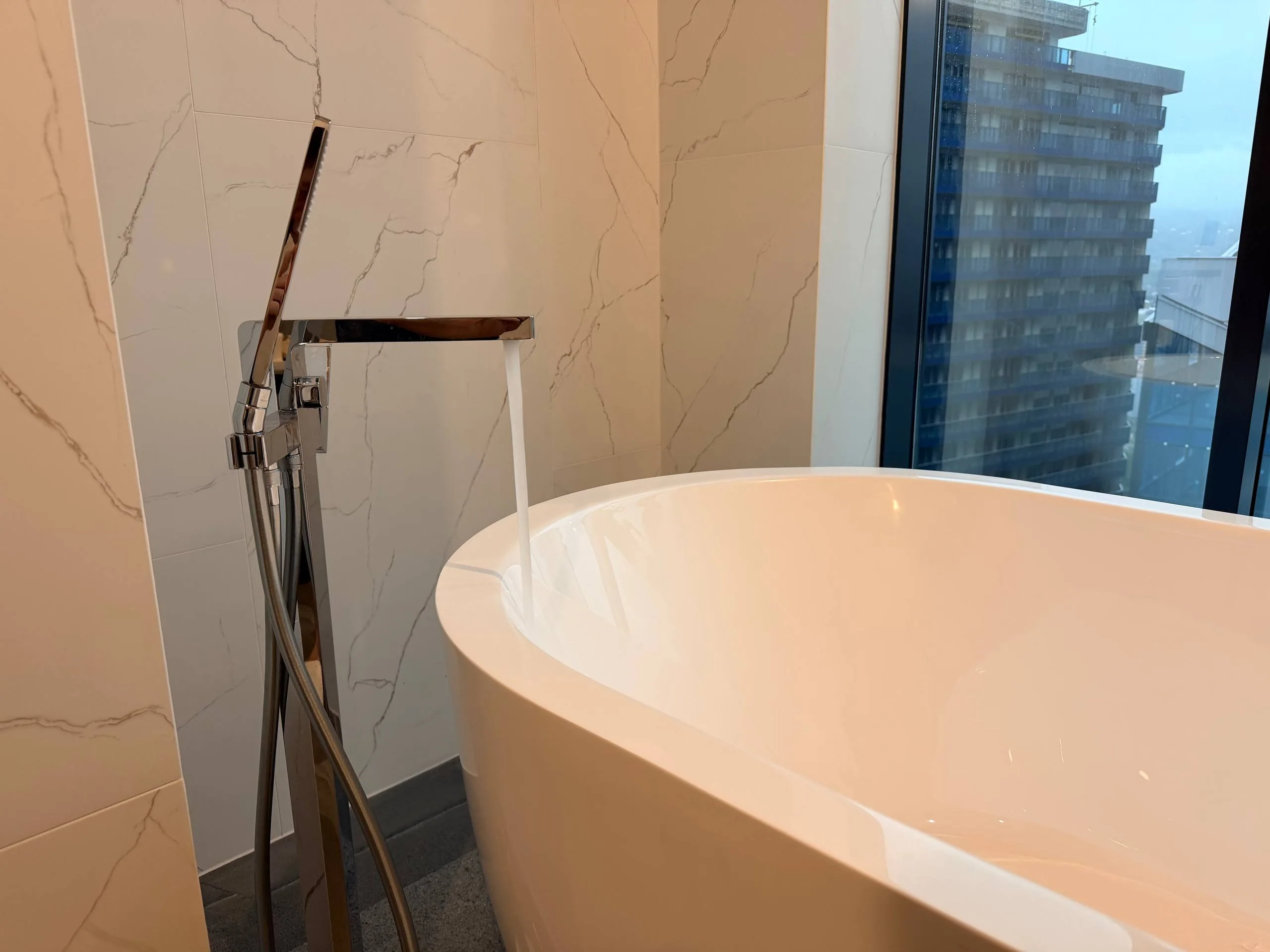

In Batumi the real choice is between steel and acrylic — cast iron is almost impossible to find here, and if you do find it, you'll pay from 1800 ₾. Steel starts from 800 ₾, acrylic from 1000 ₾. With steel, check the metal thickness — no less than 2.5 mm; with acrylic, check the sheet thickness — from 5 mm — and look for fibreglass reinforcement underneath. A freestanding bath is a separate story: prices from 3000 ₾, and it immediately calls for a floor-mounted tap, which Batumi shops almost never stock.
Which bath to choose: material, dimensions, safety
Three types of bath: acrylic, cast iron, steel
When a client says "fit a bath", the first thing I ask isn't the colour or the shape, it's the type. Because acrylic, steel and cast iron are three different characters. They take a knock differently, they hold the water's heat differently, and they cost differently. And in Batumi their availability is different too.
It all comes down to the material of the body. Steel is a thin steel sheet coated with enamel. Cast iron is a massive cast bath with enamel, heavy and warm. Acrylic is a sheet of plastic, moulded and reinforced underneath. Everything else follows from the material: weight, sound, warmth, repairability.
To keep things tidy, I'll put the essentials in a table. Further down, in the sections, I'll break each point down in more detail, but for now — the overall picture across the three types.
| Parameter | Acrylic | Cast iron | Steel |
|---|---|---|---|
| Resistance to knocks and chips | Good with thick acrylic | High, the enamel is tough | Weaker: a knock chips the enamel |
| Resistance to scratches | Medium, scratches from keys and abrasives | High | Medium |
| Deformation under weight | Doesn't deform at 5 mm and above | Doesn't deform | Flexes if the steel is thinner than 2.5 mm |
| Heat retention | Good, the water stays warm a long time | Excellent, holds longest of all | Poor, the water cools fast |
| Starting price in Batumi | from 1000 ₾ | from 1800 ₾ | from 800 ₾ |
Notes on the table:
- Starting price — this is the lower limit we actually see in Batumi shops. Cast iron is expensive not only in itself, but also because little of it is brought here.
- Deformation under weight with acrylic and steel depends on the thickness. Thin acrylic and thin steel behave entirely differently from quality examples in the same category.
- Heat retention — this parameter is usually underrated. If the family likes a long soak, steel will disappoint: the water cools while you're still lathering up.
- Scratches — acrylic's weak spot. Abrasive powder and a metal scourer leave matt marks on it that can't be removed afterwards.
In our experience, in Batumi the choice almost always comes down to steel and acrylic. Cast iron runs into a simple question: will you even find it. So further on I'll give more attention to the two people actually buy.
Dimensions and getting it up to the flat
The most galling mistake is to buy the perfect bath and not manage to carry it into the home. I've seen a cast-iron tub turned back round to the shop right from the entrance. The lift wouldn't take it, and four of us couldn't get it up the stairs. Money and a day lost.
So before buying, we always measure the carry-in route. Not "by eye", but with a tape measure, from the entrance to the bathroom. It's five minutes that save a whole ruined day.
What we check before going to fetch a bath:
- The lift's dimensions. If the bath is 170 cm long and the car is shorter, then it's stairs only, or it won't go at all.
- The width of doorways. The front door, the turns in the corridor, the bathroom door. The tight spot is usually the turn on the landing.
- Weight and the number of hands. Cast iron weighs so much that four of you up the stairs is heavy work. Steel and acrylic are lighter, but the size still gets in the way.
- Stair flights. A narrow spiral staircase in an old building is a headache all of its own for a long bath.
Now the non-obvious bit that almost everyone forgets. The bath needs to be carried in BEFORE the internal bathroom door is hung, and BEFORE the furniture arrives. A doorway without a door is wider by the frame and architraves, and an empty flat gives you room to manoeuvre.
The order is this: bath first, everything else afterwards. If the door is already hung, it has to come off along with the frame, and that's extra work and a risk of damaging the finish. Our team always plans carrying the bath in for an early stage, while the bathroom is still "bare".
Resistance of the coating to household chemicals
This is a point I consider hugely important, even though hardly anyone asks about it in the shop. And that's a shame. You'll clean the bath hundreds of times, and how the coating copes with chemicals decides whether it stays smooth in five years' time.
In the showroom everything looks equally lovely. The question is how the bath survives real cleaning. Cheap enamel and cheap acrylic go cloudy from aggressive products, yellow, lose their shine. A micro-roughness appears, dirt eats into it, and the bath looks grubby even straight after a wash.
What this affects in practice:
- Abrasive powders are acrylic's main enemy. They leave matt scratches that then collect grime.
- Acidic and chlorine products eat away at weak enamel on steel, and it goes dull around the edges.
- A quality coating comfortably handles ordinary gels and cream-based, non-abrasive products.
I always advise clients: clean the bath with mild, non-abrasive products, and it'll outlast its stated warranty. Good enamel and dense acrylic will take it, whereas budget examples "give up" in the very first year. So I check resistance to chemicals together with the thickness of the coating — they're connected things.
Safety for a family with children
When there are small children in the home, the bath stops being just plumbing. It's the place where the child is washed every day, where they sit, play and sometimes drop all sorts into it. So the criteria here are different.
Depth and design are secondary here, what matters more is convenience and predictability. Here's what families with children should look at.
- A non-slip bottom. A coating with an anti-slip zone on the bottom — the child doesn't slide off, and you won't slip yourself. For a family this isn't an option but a necessity.
- Low sides. It's easier to lower and lift a child over a low side. Your back will thank you after the hundredth bath.
- Warm water for longer. Acrylic and cast iron hold the heat, and during long baths the water doesn't go cold halfway through. Steel loses out here.
- Resistance to knocks. A thrown toy isn't going to damage cast-iron enamel or thick acrylic easily. Thin steel will chip sooner.
In short: for a family with children I don't recommend thin steel, go for acrylic or cast iron. It's not that they're pricier and more solid. They hold warm water longer and take a child's "bombardment" with toys more calmly. Thick acrylic is the best fit here on price and character — cast iron in Batumi is almost impossible to get anyway.
One more point about the sides. A tall, deep bath looks lovely in the picture, but bathing a one-year-old in it is torture. In our experience young parents don't think about this at the buying stage, and then every evening they're bending over the side. So we talk it through in advance.
Bath prices in Batumi
Let's talk money, the conversation isn't complete without it. The prices below are the starting marks we actually come across in Batumi shops. The top end is unlimited, but the lower limit shows what to expect.
| Type of bath | Starting price in Batumi | Availability |
|---|---|---|
| Steel | from 800 ₾ | Widely available |
| Acrylic | from 1000 ₾ | Widely available |
| Cast iron | from 1800 ₾ | Extremely hard to find |
Notes on the table:
- Steel from 800 ₾ — the most budget entry. But the lowest price often comes with thin metal, which gets its own discussion below.
- Acrylic from 1000 ₾ — the golden mean for most Batumi flats. Warm, light, in a normal thickness range.
- Cast iron from 1800 ₾ — and that's if you manage to find it. Cast-iron baths are extremely hard to get in Batumi, the range is almost nil.
I tell clients honestly: if you absolutely need cast iron, allow time for the search and, possibly, a special-order delivery. In an ordinary showroom it won't be sitting on the shelf. So most of our jobs in Batumi are acrylic, less often steel. Cast iron remains more of a dream than a working option.
How to choose a quality bath
How to choose a steel bath
Steel is a fine choice if you go about it sensibly. The trouble is that under the single word "steel" the shop holds both decent baths and outright junk. The difference comes down to three things: the thickness of the metal, the quality of the enamel and the rigidity of the bottom.
What matters isn't the thickness the salesperson quotes, but the one written in the product passport. Now point by point.
- Steel thickness no less than 2.5 mm. This is an ironclad rule. Any thinner and the bath flexes under weight, makes noise as the water runs and clangs when you sit down in it. This figure should be on the price tag — ask the salesperson or check the product passport. No figure, no purchase.
- Enamel thickness. Thin enamel will chip in the very first year of use. Good enamel looks uniform: no roughness and no runs along the edges. Run your eye along the sides — drips and unevenness give away a cheap layer.
- Checking the bottom for flex. Stand next to the bath and press your hand into the centre of the bottom. The bottom shouldn't give or flex. If it "breathes" under your hand, it'll be even worse under a person's weight, and the enamel on a bottom like that cracks.
It sounds like nitpicking, but those are exactly the three checks that separate a bath that lasts ten years from one that lasts two seasons. I do them right there in the shop in front of the client, and the salespeople are used to it by now. Don't be shy about pressing on the bottom and looking into the passport — it's your money.
How to choose an acrylic bath
Acrylic is our most frequent choice in Batumi, and it's usually the one I recommend. Warm, light to carry in, in a wide range. But here too, beneath a handsome glossy tub there can be thin plastic that gives way under weight.
The shine of the front side tells you nothing. Look at the thickness of the sheet and at what's underneath the bath. Two parameters that decide everything.
- Acrylic thickness. At least 5 mm, and better from 6 mm. Thin acrylic springs, creaks and loses its shape over time. Thick acrylic holds weight and a knock with confidence.
- The reinforcing layer underneath. Fibreglass plus resin, without fail. Look at the underside: a quality bath has a dense white or grey layer of reinforcement there. A budget one — just thin plastic with no reinforcement.
The glossy front surface is roughly the same on all of them, the whole truth is on the back. Dense reinforcement of fibreglass and resin tells you the bath won't dent and won't crack along the corners.
In our experience, it's the reinforcement that's most often skimped on in cheap models. The acrylic thickness might still be quoted honestly, but the buyer almost never checks the underside. So we always look under the bath in the shop — it's five seconds that show the bath's class.
General rules for buying
There are a couple of rules that work for any type of bath, whether steel or acrylic. They're simple, but they're exactly the ones most often broken, and then people are surprised by chips.
You go to the shop not for the picture in the catalogue, but for a specific bath. And there are nuances with it.
- Don't take the display bath. Display models pick up micro-chips and scratches over their time in the showroom. People touch them with their hands, lean on them, put boxes on them. Take a new one, in factory packaging.
- Ask about the warranty and keep the paperwork. The warranty card and the receipt are your insurance. Put them in the folder with the flat's documents, don't throw them out.
- Choose models with a warranty of 5 years or more. A long warranty is an indirect sign that the maker is confident in the coating and thickness. A short warranty should put you on guard.
I always repeat: a bath is fitted for ten to fifteen years, it's not the kind of purchase where you save on a marked-down display model for a hundred lari off. Our team takes only packaged baths and checks the set of documents before paying. The papers come in handy later if a factory defect happens to show up.
A freestanding bath and a floor-mounted tap
Freestanding baths for a designer renovation
A freestanding bath is already about design, not hygiene. It stands in the middle of the bathroom on feet or on a plinth, with no contact with the walls. A completely separate class in price and in approach.
The difference from an ordinary bath is fundamental — both in budget and in the pipework. Straight to the money: prices for freestanding ones start at roughly 3000 ₾ and go up. The most we've come across in Batumi is up to 12 thousand lari for a bath. That's the range for a designer renovation, where the bath becomes the centre of the composition.
A few practical notes on freestanding baths:
- Starting price. From ~3000 ₾, and the upper limit in local shops reached 12 thousand lari.
- Where to look in Batumi. Freestanding baths are excellently represented at the Jaokeni shop — there's a huge choice of shapes and sizes there.
- Space for installation. The bath needs access from all sides, you can't shove it into a corner. This is sorted at the bathroom design-project stage, not after the fact.
If you're doing a designer bathroom, my advice is to go and look at freestanding baths specifically at Jaokeni — there's genuinely plenty to choose from there. But bear in mind that a beautiful bath is only half the story. The other half is the tap, and that's a separate conversation.
A floor-mounted tap for a freestanding bath
This is where clients get caught out. They've chosen a luxurious freestanding bath, but it can't be connected to the wall — the mixer has to stand on the floor. And it turns out that a floor-mounted tap is harder to find in Batumi than the bath itself.
So the rule is ironclad: budget for the tap straight away, on the same day as the bath, not "we'll figure it out later". There are few floor-mounted mixers in Batumi, the choice is frankly meagre. If you don't allow for it in advance, the renovation grinds to a halt at the connection stage.
Where to look for a floor-mounted tap:
- Domino — the best option. It's not in Batumi itself, but at Domino you can order online. For choice and quality it's the first thing I recommend.
- Aqaroom. A workable option, worth dropping in and looking at the range.
- Modus — sometimes. It's in stock now and then, but inconsistently, you shouldn't count on it as your main source.
- A Turkish online shop. You can pick a tap in Turkey with delivery to a border town — Trabzon or Rize. Sometimes it works out 30% cheaper.
About the Turkish option I'll be honest about both sides. You must factor customs clearance into the price — without it the calculation is incomplete, and "30% cheaper" can melt away. On the plus side, though: a trip to Turkey for a tap is a chance to drink some good Turkish coffee and just have a great day out. Many of our clients combine the trip with a little weekend break.
In our experience, it's the floor-mounted tap that's the main hidden expense of a designer bathroom. The bath itself is in plain view, people think about it, while the mixer surfaces at the last moment. So at Level Up we discuss it together with the choice of the freestanding bath, so there are no surprises later.
Accepting the bath
Buying a good bath is half the job. The other half comes down to acceptance: at the warehouse and on the first day after installation. This is where you catch the defects that are later long and tedious to prove under warranty.
Acceptance protects your money, so I don't regard it as a formality. I split it into two stages.
The first stage is at the warehouse, before you've signed for the goods. Inspect the bath from all sides in good light: look for scratches, chips and cracks. Check the sides, the bottom, the corners, the underside. Any defect found here is grounds to swap the item on the spot, rather than haul the problem home.
The second stage is on the first day after installation. Wash the bath thoroughly: a clean surface immediately shows whether there's any break in the integrity of the coating that was invisible under the factory grease and dust. After that, fill the bath fully with water and check the tightness of the connection — whether there are any leaks under the tub and at the joints.
Check straight away, don't put it off for later. In our experience a leak or a micro-chip surfaces on the very first day, while it's still easy to put right and to lodge a claim. Our team hands the bath over to the client only after filling it with water and inspecting the washed surface — it's the standard acceptance procedure.
FAQ
Summary
- The real choice in Batumi is steel or acrylic. Cast iron is extremely hard to find here, even at a price from 1800 ₾.
- Starting prices: steel from 800 ₾, acrylic from 1000 ₾, cast iron from 1800 ₾. Freestanding ones — from ~3000 ₾, up to 12 thousand lari.
- Take steel from 2.5 mm metal thickness, otherwise it flexes, makes noise and clangs. Check the figure in the passport.
- Take acrylic from 5 mm, better from 6 mm, with dense fibreglass-and-resin reinforcement underneath, not with thin plastic.
- The enamel should be uniform — no roughness or runs along the edges; thin enamel will chip in the first year.
- Check the bottom for flex: press your hand into the centre, it shouldn't give.
- For a family with children, acrylic or cast iron is better — they hold heat longer, and enamel and thick acrylic aren't bothered by a thrown toy.
- Carry the bath in before the bathroom door and furniture are fitted — afterwards the doorway and the space may not be enough.
- Don't take the display model, keep the warranty and choose models with a warranty of 5 years or more.
- For a freestanding bath, budget for a floor-mounted tap straight away — Domino online is best, also Aqaroom and sometimes Modus; the Turkish option is cheaper, but with customs clearance.
- Acceptance is a must: inspection at the warehouse from all sides, and on the first day — washing and filling with water to check the coating and tightness.