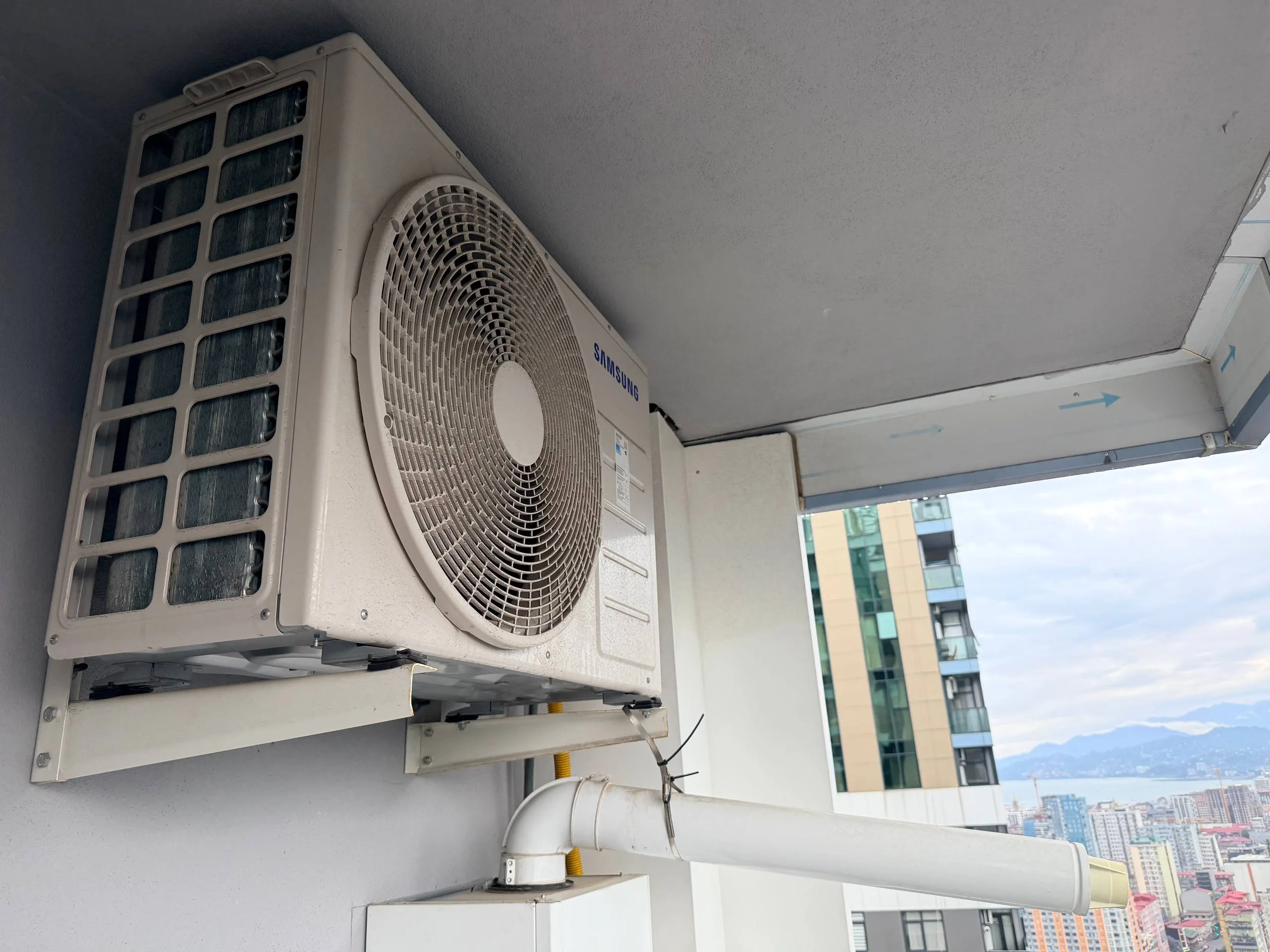

In Batumi an AC isn't just for cooling — without heat pump mode and a dehumidifier function life here is rough: the real enemy in summer isn't heat, it's humidity, and in winter you need heat. Size capacity at 1 kW per 10 m², plus a +15–20% margin for sunny exposures and floor-to-ceiling windows. Pick a model running on R32 refrigerant, with at least 36 months of warranty and an A++ or A+++ energy class. And don't buy in May–June: in the low season prices drop by 20% and the installer shows up the next day.
Why an AC in Batumi isn't just about the heat
I already gave the short answer above for the impatient. But if you're setting up an apartment on the coast for the first time, let me walk through it properly. The main mistake newcomers make is treating an AC as just a cooling box. In Batumi it works the whole apartment's climate year-round.
In summer here you don't suffer from temperature. You suffer from humidity. The air is thick and wet, +30 °C feels like +36 °C because sweat doesn't evaporate. From our experience on site, a client first complains about the heat, and after dehumidification is set up they say "I can just breathe again." And the damp and rain here aren't a couple of summer months — they last all year.
The takeaway is simple: an AC needs to do three things. Cool in summer, dry the air during damp spells, and heat the apartment in cold months. These aren't "future-proofing" options — without them the device just doesn't fit Batumi.
That's why when choosing I look at two things first. Heat pump mode — proper heating, not "slightly warm air." And the dehumidifier function — a dedicated drying mode where the unit pulls moisture out almost without changing the temperature. Without those two checkboxes the purchase is half useless.
We at Level Up don't cut corners on this advice. A cheap "cooling only" unit will live in Tbilisi — not here. The local damp turns that purchase into a painful mistake by the first autumn: walls start pulling moisture and there's nothing to heat with.
One more observation from sites. People underestimate how dehumidification affects the renovation itself. High humidity means mould in corners, swollen doors, peeling paint. An AC with dehumidification keeps humidity in check and the finishes last longer. So picking climate gear in Batumi also protects the apartment — not just your personal comfort.
How to size capacity and the line run
Start by sizing capacity
Before you walk into a store and let a salesperson talk, work out the split-system capacity you need yourself. It takes five minutes and saves you from two extremes — an underpowered unit that roars at full speed and can't keep up, and an oversized one you overpaid for that doesn't dehumidify well.
Here's how I count it. A split-system indoor unit goes in every separate room in the apartment: one for the bedroom, one for the living room. If the budget allows, we hang one even in the bathroom. In the local climate that's damp protection, not luxury.
A rough formula: 1 kW of cooling per 10 m² of floor area. It's a simplified rule of thumb, not an engineering calculation, but it's enough for picking a model. Then convert kilowatts to BTU — that's how units are labelled in Georgia.
| Label | Capacity | Room area |
|---|---|---|
| 7000 BTU | ≈ 2 kW | up to 18 m² |
| 9000 BTU | ≈ 2.5 kW | 18–25 m² |
| 12 000 BTU | ≈ 3.5 kW | 25–35 m² |
| 18 000 BTU | ≈ 5 kW | 35–50 m² |
| 24 000 BTU | ≈ 7 kW | 50–70 m² |
Notes on the table:
- BTU is the "price-tag language" in Georgia. The store won't show you kilowatts, everything is in thousands of BTU. Remember at least two reference points: 9000 BTU covers a regular bedroom, 12 000 BTU covers a living-room studio.
- Calculate by individual room area, not by the whole apartment. One 24 000 BTU unit for a whole studio is worse than two 9000s in the bedroom and the living room: air doesn't go around corners and through doors.
- Don't round down "to save money." A weak unit runs at its limit, wears out faster and dehumidifies worse. Better to take a small margin than to skimp by half a size.
- A margin isn't "take the maximum." A heavily oversized inverter hits the target temperature fast, drops to low revs early and pulls moisture poorly. In damp Batumi that's a noticeable downside.
The Batumi correction: sun and floor-to-ceiling windows
The table above is for an average apartment in a temperate climate. Batumi adds its own correction, and you need to factor it in at the sizing stage. Discovering in July that the unit can't keep up is a doubtful pleasure.
There are two specifics. First — orientation. South and west walls hold direct sun all day, and the room behind them heats up more than the calculation says. Second — floor-to-ceiling glazing. In new coastal buildings it's the norm: a wall-of-glass looks great and lets just as much heat in.
That's why to the calculated AC capacity I add a +15–20% margin for sunny south and west rooms with large windows. Roughly: where the table would call for 9000 BTU, for a floor-to-ceiling west-facing living room I'd plan 12 000 BTU. A north-facing bedroom with a regular window doesn't need that margin — the base formula works there.
In a regular apartment people size by area and forget. In a Batumi seaside new build, area is only half the equation. The other half is how much sun and glass a room gets.
Because of that, two rooms of the same square metres need different units. A north bedroom of 20 m² is comfortably covered by a 9000 at 2.5 kW. A west-facing 20 m² living room with a stained-glass window facing the sunset already asks for 12 000 BTU. Put the same 9000 in there and it'll run at its limit during the hottest hours and pull neither cold nor moisture. So the Batumi margin is a sober calculation against a specific wall and a specific window, not paranoia.
The line run — the thing people forget before buying
It's not printed on the price tag, and almost nobody thinks about the line set at the store. And it hits the budget and the system's performance directly. The line set is the copper tubing between the indoor and outdoor unit.
The standard factory kit is 3 metres. That's enough when the outdoor unit hangs right behind the wall under the window. In large Batumi complexes that's rare: outdoor units are moved out to service balconies or special niches, sometimes quite far from the room, for the sake of a uniform façade.
Here's the catch. Every metre of line set beyond 5 metres requires extra refrigerant charging — that's additional labour and money at installation. The max for residential models is usually 15–20 metres: beyond that efficiency drops and the manufacturer no longer guarantees performance. You need to understand all this before buying, not learn it from the installer on site.
- Measure the actual line run in advance. Not in a straight line through the wall, but along the real path: down the wall, along the balcony, up to the outdoor unit's spot. That number changes the quote.
- Beyond 5 metres — budget for a recharge. If it's 9 metres to the service balcony, four metres above the standard are paid for in refrigerant and labour. That's not the installer ripping you off, that's physics.
- Longer than 15–20 metres — rethink the layout. Pushing a residential unit to its limit is a path to weak cooling and rapid wear. Sometimes a different spot for the outdoor unit is cheaper and more correct.
- Two balconies — two ACs. If, say, the apartment has two balconies on opposite sides, don't try to serve everything with one long line. In our experience two separate ACs end up more reliable and often cheaper to install.
Which type of AC to choose
Inverter or on/off
This is the second question after capacity, and there are a lot of myths here. The market has two types: inverter and on/off, the classic kind. The difference is in how the compressor works.
A regular on/off works on a "switch on — switch off" principle. It hits the set temperature — the compressor stops. The air warms up — it fires back up at full power. An inverter smoothly varies its revs: when it's hot it goes to maximum, when the target is reached it drops the power and maintains it without full stops.
The analogy I usually give clients. A regular AC is a car that accelerates to 100 km/h, stalls, fires up again and goes back to 100. An inverter is a car with cruise control, holding steadily at 60 km/h. The second option is more comfortable, quieter and cheaper to run.
But there's a local caveat, and it matters specifically for Batumi. The inverter has more electronics, which makes it more vulnerable to voltage spikes. And the power grid here can be temperamental in places. If your building has voltage swings, the inverter's board is the first thing to fail.
The advice here is marketing-free. Where the grid is stable — get an inverter, it's worth it. Where the grid is troublesome — two options: either an on/off classic that takes spikes more calmly, or an inverter together with a voltage stabiliser. At Level Up we always plan for a stabiliser on troubled lines — it works out cheaper than replacing a burnt-out board.
How do you tell if your grid is a problem or not? Ideally — ask neighbours who've already lived a season in the building, and watch whether the lights flicker when appliances kick on. In older stock and in some new builds with under-spec service entries, spikes happen more often. If you have no data and still want the inverter — get it with a stabiliser straight away, it's insurance for years to come. The stabiliser premium is nothing compared to the cost of a new board and a season lost to repairs.
And one more argument for the inverter that, for most apartments, tips the scales. It uses less electricity while holding temperature steadily, without the "cold — stuffy — cold" swings that the classic on/off suffers from. In a damp climate that stability is doubly valuable: a smooth regime manages humidity better than the jagged on/off cycle.
When you need a multi-split
If you have a studio, you can skip this section — one unit will do. But the moment you've got more than one room, several separate split systems have an alternative. It's the multi-split: one outdoor unit on the façade and several indoor units across the rooms.
The main scenario where you can't go without a multi-split is when the façade only allows one spot per apartment for the outdoor unit. In Batumi that's common. New builds with a unified architectural look don't let you hang three "boxes" on the wall. In Old Batumi you can't touch the historic façade at all.
There's a money argument too, and it pays off over the years. Maintaining a multi-split is cheaper than several separate splits: cleaning and recharging refrigerant happens in one outdoor unit, not three. In a coastal climate, where service is needed regularly, the savings are noticeable.
A single big unit looks like a compromise, like "everything dumped onto one." In reality, for an apartment with strict façade rules a multi-split is the only way to cover all the rooms without breaking the building's regulations.
There's a flip side, and I warn about it honestly. If the multi-split's outdoor unit fails — the whole apartment loses climate at once. With separate splits, one failing unit leaves the others working. So the choice depends on the apartment: how much façade freedom you have, how many rooms, how important cheap servicing is. In our experience, for two or three rooms in a new build with a uniform look, multi-split almost always wins.
Buying and installing in Batumi
Where to look at ACs in Batumi
Now to the practical side. People look at ACs in Batumi at the big home-appliance stores. I usually send clients to three places: Elit Electronics, Alta and Kontakt. They have a showroom, consultants and stock on hand — not just made-to-order units.
A tip from our crew: come to the store with numbers in hand. You know the room areas, you've sized the BTU from the table above, you've measured the line run. With that, the conversation with the salesperson is about your case, not "this one's popular." You're running the choice, not them.
What to check at purchase
For the model you like there are four parameters I always check. They're not in the most prominent spot on the price tag, but they're the ones that decide how the unit will live in the local climate and how it'll handle your use case.
| Parameter | What to take | Why specifically for Batumi |
|---|---|---|
| Refrigerant | R32, not R410a | More modern, greener, more efficient |
| Warranty | 36 months or more | Sea air is an aggressive environment, you need insurance |
| Energy class | A++ minimum, ideally A+++ | Lower power bill, faster payback on a rental |
| Wi-Fi | mandatory for rentals | Control and monitor the apartment without the owner |
Notes on the table:
- R32 vs R410a — take the newer one. R32 is a modern refrigerant: it transfers heat better and is greener. R410a is still around in warehouses, but it's on its way out, and I wouldn't take it.
- A 36-month warranty isn't marketing, it's a necessity. Salty sea air ages equipment faster than inland. Three years of warranty is real insurance against early failures.
- A++ as a minimum, A+++ if it's for rental. The higher the class, the lower the bill. For a short-stay apartment that's direct savings and a faster payback on the investment.
- Wi-Fi is for rentals, not for show. Renting out, you need to switch cooling on before the guest arrives and control the mode remotely (or via a smart-home setup). Without Wi-Fi that's impossible: you either pay for it running empty, or the guest walks into a stuffy room.
Service and parts on the ground
The purchase is half the story. The other half begins when the unit breaks, and in Batumi that moment decides how well you picked your brand. Local specifics differ sharply from what people are used to in big cities.
The main thing to know: Batumi has a Midea service centre. There are no authorised LG or Samsung service centres here. That doesn't mean Samsung can't be fixed — it can, but through third-party shops or the seller's own service, e.g. Elit Electronics or Alta. The route is just longer and less predictable.
The second local specific is parts. For many brands they're shipped from Tbilisi, which means 1–2 weeks of waiting. Being without an AC for two weeks at the peak of the season is no fun. With Midea there's no such issue: both service and parts are on the ground.
I'm not saying Midea is the only correct choice. But all else being equal, having local service in Batumi is a serious plus for peace of mind. If your heart is set on another brand, find out in advance who's going to fix it and how long it'll take.
This matters especially for a rental apartment. Here a breakdown isn't just discomfort — it's a ruined review and a refund to the guest. Two weeks waiting on a part from Tbilisi at peak season means several cancelled bookings. So for rentals I look at service even more strictly than for myself: the unit has to be fixable fast and on the ground. For your own home you can afford to wait; for a rental business every day of downtime costs money.
When to buy an AC
The last point is about money and timing, and it's underrated. If there's no burning deadline tied to the season, the purchase doesn't have to be rushed and you can catch a good month. Price and installer availability depend on the month more than on the model.
Don't buy a split system in May–June. That's peak demand: prices are higher and installers are booked 2–3 weeks out. You pay more and still wait for installation in the hottest part of the year. The worst possible combination.
The best time is low season: February–March or October–November. Discounts reach 20% and the installer comes the next day because there's no queue. If you're doing the renovation in advance, schedule the AC purchase and installation specifically for those months — at Level Up we always plan client timelines around exactly that.
Run a simple example. A pair of ACs for a two-bedroom in June will be full price with a 2–3 week installation wait. The same set in March — up to 20% off and installed tomorrow. On two units the savings are tangible and you'll save even more nerves. The only reason to buy in peak season is if an AC died in the middle of the heatwave and you can't tough it out. In every other case plan ahead and buy in the shoulder season.
FAQ
Outcomes
- An AC in Batumi is a climate system, not a cooler. Heat pump mode and the dehumidifier function are mandatory: the summer enemy is humidity, and in winter you need heat.
- Size capacity yourself, before the store. The base formula is 1 kW of cooling per 10 m²; in Georgia it's labelled in BTU, so convert from the table.
- Build in a +15–20% margin. Sunny south and west rooms with floor-to-ceiling windows in seaside new builds need a capacity buffer.
- Plan the line run in advance. The standard is 3 metres; every metre beyond 5 needs extra refrigerant, and the residential limit is 15–20 metres.
- An inverter is more comfortable but afraid of voltage spikes. On a troubled grid take an on/off or fit a stabiliser; two balconies — two ACs.
- Not a studio — look at multi-split. A single outdoor unit on the façade solves the uniform-look problem and Old Batumi rules, and maintenance is cheaper.
- Buy ACs at Elit Electronics, Alta or Kontakt. Come with numbers ready: area, BTU and line run.
- Check four parameters. R32 refrigerant, warranty from 36 months, class A++ or A+++, and Wi-Fi for rentals.
- Account for service. Batumi has Midea service and parts on the ground; for LG and Samsung it's harder, parts ship from Tbilisi 1–2 weeks.
- Buy in the low season. Not May–June, but February–March or October–November: up to 20% off and the installer comes the next day.