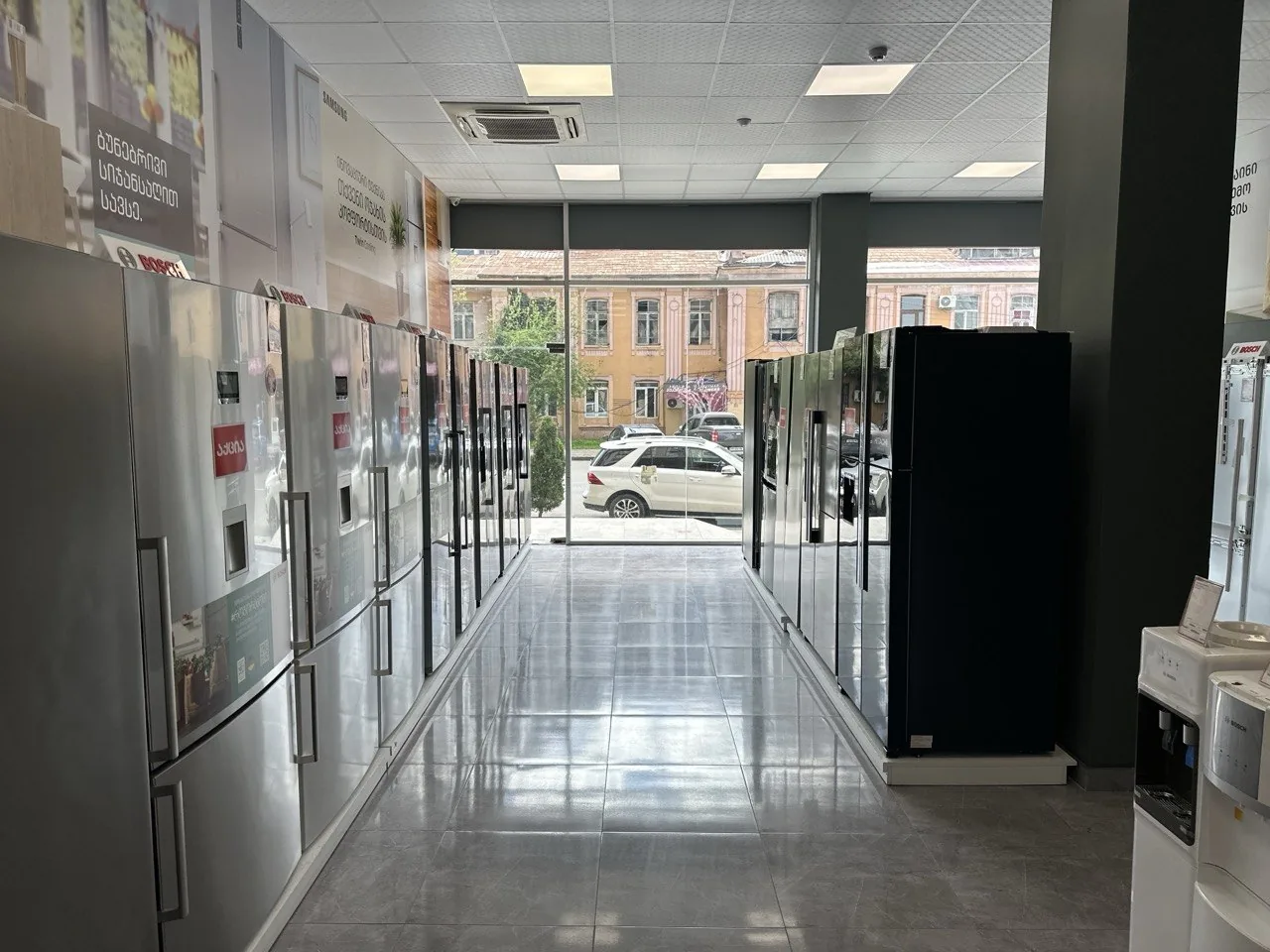

You don't choose a fridge in the shop — you choose it back at the kitchen-planning stage, because it dictates the dimensions and structure of the entire run of units. You size the volume by the number of residents: 120–150 litres for the first person plus 60–80 litres for each additional one. A built-in fridge is more stylish, a freestanding one holds more and comes with features like an ice maker. For a rental flat, a small bar fridge is plenty. And do measure the lift and the doorway before you buy, not after — a Side-by-Side won't fit in the standard lift cabin of a Batumi new-build.
How to choose a fridge
Why a fridge is chosen at the kitchen-planning stage
When a client shows me their kitchen design, the first thing I ask about is the fridge. Not the colour of the cabinet doors, not the worktop — the fridge. It surprises a lot of people. But the fridge is precisely what sets the framework for the whole kitchen.
A fridge is an important thing. It hugely raises the comfort of a kitchen, and how you live in the flat overall depends on it. That's why we define what it has to do back at the planning stage. Buy it later and shoehorn it in somehow — that doesn't work. We settle it now and build everything else around it.
The kitchen layout, its dimensions and its structure all depend on the fridge. Put in a wide Side-by-Side and it'll swallow an entire wall, and the units will have to be squeezed down. Go for a narrow built-in and you free up space for appliances and cabinets. It's the starting point at the beginning of a renovation, not a detail at the end.
The choice of fridge depends on three things: the number of residents, the class of the renovation, and lifestyle. A family of four and a couple without children live differently, cook differently, shop differently. Some buy groceries a week ahead, some pop into the shop every evening. These scenarios call for different fridges, and it's settled before the first screw is bought.
In our experience at Level Up, a mistake with the fridge almost always traces back to the design stage. First a beautiful kitchen gets drawn up, then it turns out the desired fridge doesn't fit into it. Then the compromises begin: either squeeze the units down or swap to a less convenient model. Both options are a shame, because they were so easy to avoid.
Now in order. First we'll sort out the type of fridge, then we'll size the volume, then we'll find where to save, and we'll finish with the most painful details — the socket and getting it up to the floor. We walk this path with every client.
Built-in or freestanding
The first thing you need to settle is a built-in fridge or a freestanding one. It's a fork in the road that affects the kitchen design, the budget and the set of features. The point here isn't so much the price as the logic.
Built-in fridges are a touch more stylish. They hide behind the cabinet door, the kitchen looks unified, with no white box sticking out. You pay for those good looks in volume: for the same niche dimensions, a built-in holds less than a freestanding one. Part of the space is eaten by the housing it sits in.
Freestanding ones are the opposite. They hold more, and they more often come with interesting features: an ice maker, a mini-bar, a separate fresh zone. In built-in models this is either absent or commands a much higher price. Stylish but cramped versus noticeably roomier, plus the kit and the litres — that's the choice.
Kitchen-design specialists are a good help when it comes to picking a specific model. They have examples of real jobs, you can see finished models in the flesh that are actually sold in Batumi. That's better than choosing from pictures on the internet, where half the items aren't brought over here.
Now about money. Built-in fridges in Batumi start at roughly 1200 ₾. A good solution at that budget is the MIDEA MDRE353FGE01: a no-nonsense workhorse, worth its money. If you want to move up to the middle or premium category, there's the BOSCH KIS87AFE0 — a noticeably pricier model, around 4000 ₾. Let me put the reference points in a table.
| Option | Type | Starting price in Batumi | Who it suits |
|---|---|---|---|
| MIDEA MDRE353FGE01 | Built-in | from 1200 ₾ | Budget, a tidy integration behind a cabinet door |
| BOSCH KIS87AFE0 | Built-in | ~4000 ₾ | Middle/premium, quiet operation and durability |
| Freestanding with features | Freestanding | depends on the model | For those who want litres, an ice maker, a mini-bar |
Notes on the table:
- MIDEA MDRE353FGE01 is a sensible lower bound for a built-in fridge. For 1200 ₾ you get a perfectly decent, no-nonsense working fridge.
- BOSCH KIS87AFE0 is three times the price, and the premium goes on quietness, durability and build. If the renovation is premium, that difference is justified.
- The freestanding option has no fixed price for good reason: the spread is huge, because the category contains both simple two-compartment units and fully loaded Side-by-Side models.
In short: if you want a unified kitchen and you're prepared to lose a few litres, go for a built-in. If you need volume and features, look towards a freestanding one. Our crew has fitted both, and there's no universal answer here. There's only your way of life.
What volume you need: sizing by residents
Volume is where people get it wrong most often. They take "a bit bigger, to be safe" or "a bit smaller, to be cheaper", when all you need to do is work it out. The formula is simple, and I give it to every client.
We count like this: 120–150 litres for the first family member plus 60–80 litres for each additional one. It's a workable benchmark; on our sites it lines up with real life. Plug in the number of residents and you get the volume range to aim for.
So you don't have to do sums in your head, I've gathered the ready figures into a table. It shows clearly: between one person and a big family, the spread isn't measured in percentages but in multiples.
| Household | Recommended volume | Comment |
|---|---|---|
| 1 person | 150–250 l | Plenty with room to spare, a built-in works |
| Couple | 250–350 l | The most common scenario in new-builds |
| 3–4 people | 350–450 l | A full two-compartment unit is now needed |
| 5 people or more | from 500 l | Either a big fridge or that plus a freezer |
Notes on the table:
- 1 person, 150–250 l. A compact built-in fits comfortably here. A large volume is simply pointless for one person; it'll be running for nothing.
- Couple, 250–350 l. This is our most common case in Batumi flats. Most standard models suit this volume.
- 3–4 people, 350–450 l. A family scenario, where two full compartments and a proper freezer already matter.
- 5 or more, from 500 l. Here it's either one big fridge or a "fridge plus separate freezer" pairing. The second option is often more convenient: the freezer can be moved out onto the balcony or into the storeroom.
The idea is simple: a small household has no use for a big fridge, and a big family will categorically run short with a small one. It's not about the money here. What matters is that the volume matches the real number of mouths to feed. Land in your range on the table and the fridge will be neither half-empty nor stuffed to bursting.
How to find a cheaper alternative
This section saves people thousands of lari, which is why I love telling it. The point is that many brands build almost identical appliances and price them very differently. You can catch that difference with your own hands in five minutes.
Go to the seller's website, type in the parameters of your chosen model — volume, dimensions, type, energy class. Then set a filter on other brands and see what comes up with the same specs. You'll often find an identical equivalent, sometimes built in the very same factory from the very same components, just under a different logo.
Let me show you with a real example I checked myself. Take the GORENJE NRS9182VXB1 for 3499 ₾ and the BOSCH KAG93AI304 for 6599 ₾. The specs are almost identical, the appearance is the same. Yet the price differs by nearly double — a difference of around 3000 ₾. Let me put it in a table to make it clearer.
| Model | Price in Batumi |
|---|---|
| GORENJE NRS9182VXB1 | 3499 ₾ |
| BOSCH KAG93AI304 | 6599 ₾ |
Notes on the table:
- The price difference is around 3000 ₾ for comparable specs. That's not pennies, that's half the budget for the appliance itself.
- "Almost identical" is an honest phrasing: the match isn't a hundred percent on every last screw, but on what matters in everyday use you won't notice a difference.
- The appearance is the same, so in the kitchen neither you nor your guests will tell the cheap model from the expensive one.
I'm not urging you to reject premium brands on principle. Sometimes the premium for the name is justified — it runs quieter, it lasts longer. But that has to be decided deliberately; running on the inertia of "BOSCH means better" is a poor adviser. Compare the parameters, and if they match, a difference of 3000 ₾ is better settling in your pocket than in the shop's margin. At Level Up we always advise the client to take this step before buying.
A fridge for a flat let on short-term rental
A rental flat is a separate case, and the logic here is the opposite of a home one. At home you optimise for yourself and your family. For a rental — for costs and the guest's short scenarios.
For a flat let on short-term rental, the effective move is a small bar fridge. It draws little electricity and is relatively cheap to buy. A solid big fridge for guests isn't needed here; a compact one sized exactly to the task is enough. A decent model is the GORENJE R29EPW4, priced at roughly 390–440 ₾.
Think about what a tourist needs a fridge for over two days. They're not going to cook five-course dinners here. It's enough for the guest so the souvenir cheese they bought doesn't spoil over one or two nights, so there's somewhere to keep water, yoghurt and a couple of bottles. A bar fridge covers that completely.
A big fridge in a rental flat is money down the drain twice over. It's dearer to buy and dearer in electricity, which is often included in the cost of the stay and paid out of your pocket. In our experience, owners of rental apartments almost always switch to bar fridges as soon as they tot up the annual costs.
Common mistakes and details
The socket: a renovation detail people forget
Now about the detail that surfaces after the renovation, when redoing it is expensive. It's about the socket for the fridge. Seems like a trifle, yet it ruins both the look and the convenience.
The socket for the fridge needs to be brought out to the side of it, not behind it in the centre. In Batumi it's done the other way round all over the place — right behind the fridge, in the centre of the back wall. That's a mistake, and I explain why on every job.
If the socket sticks out behind the fridge in the centre, the plug and cable stop it sitting flush against the wall. You lose 3–5 cm, the fridge juts forward, and in a narrow Batumi kitchen that's noticeable. And there's no getting at such a socket when you need to unplug the fridge — you'll have to drag the whole hulk out.
Bringing the socket out to the side, where a hand can reach it, is the right option — rather than hiding it prettily behind the body. To the side, the socket doesn't stop the fridge pressing against the wall and is always accessible. It's five minutes of work for the electrician at the wiring stage and zero headache later. Our crew only fits the fridge socket to the side — proven over dozens of kitchens.
Why you shouldn't buy "for the future"
A telling story from life. My friend was buying a fridge "for the future": there were two of them, but they took a big one with room to spare — the idea being that a family, children, would come along and it would come in handy. Sounds reasonable. In practice it turned out otherwise.
The logic of "I'll take a bigger one in case a family comes along" works badly. An extra 150 litres of volume isn't free. That's plus 20–30% to the electricity consumption, and that surcharge drips away all the years of waiting while the family still hasn't appeared. The fridge hums half-empty and pulls money out of the socket every month.
Then the arithmetic gets even more interesting. A fridge lasts 10–15 years. Over such a span the technology manages to change noticeably: new compressors, new energy classes, new features. By buying "for the future" today, you freeze money in an appliance that will already be outdated by the time the real need arrives.
So the advice is simple and honest, the opposite of the usual "buy with room to spare". Buy a fridge for your current needs, and leave the imagined future to the future. There are two of you now — buy for two; by our table that's 250–350 l. And in 7–10 years, when the make-up of the family really changes, buy a new one for the changed needs and with up-to-date technology into the bargain. That's what I'd have done, and that's what, in the end, my friend regretted not doing.
Dimensions and the lift: the main trap
I left this for last, because it's the most painful mistake of all. You can size the volume perfectly, find a good-value model, run the socket out correctly — and then fail to get the fridge into the home. I've seen it happen, and it's a sad sight.
The main rule: before you buy, check whether the fridge fits in the lift and through the flat's door. Not by eye, but with a tape measure. This applies especially to large models. A Side-by-Side 90 cm wide and more won't fit in the standard lift of a Batumi new-build — the internal width of the cabin here is usually 80–85 cm. It just won't go in, that's all.
Then the expensive improvisation begins. Carrying a fridge up to the 12th floor by the stairs is plus 100–200 ₾ for the movers and a real risk of damaging the body on the turns. And in many buildings it's outright impossible: narrow flights, sharp turns, nowhere to swing the bulk around. I've gathered what to measure in advance into a list.
- The internal dimensions of the lift. The width, depth and height of the cabin. A Side-by-Side of 90+ cm won't go into an 80–85 cm cabin.
- The flat's doorway. The entrance door, the clear width. Bear in mind the door frame eats up several centimetres.
- The turns on the stairwell. The landings, the turns, the railings. The tight spot is usually right here, not on the straight flight.
- The dimensions of the fridge itself in its packaging. In the box the appliance is wider than in the specs. Measure by the packaging, not by the bare body.
It's like with the socket here: you have to think ahead. First we measure the route, then we buy what is sure to fit. Hoping to work it out on the spot is how fridges end up left standing in the stairwell. Measure the lift, the doorway and the stair turns before you buy. It's five minutes with a tape measure versus a failed delivery, a damaged body and extra money for the movers. At Level Up we do this measuring for the client.
FAQ
Summary
- A fridge is decided at the kitchen-planning stage. The size and structure of the units depend on it, not the other way round.
- Volume is sized by residents. 120–150 l for the first plus 60–80 l for each additional one: 150–250 l for one, 250–350 l for a couple, 350–450 l for a family, from 500 l for five.
- A built-in is more stylish, a freestanding one holds more. Built-in from 1200 ₾ (MIDEA MDRE353FGE01), premium around 4000 ₾ (BOSCH KIS87AFE0).
- An equivalent under a different brand saves up to 3000 ₾. The GORENJE NRS9182VXB1 for 3499 ₾ versus the almost identical BOSCH KAG93AI304 for 6599 ₾.
- For a rental, get a bar fridge. The GORENJE R29EPW4 for 390–440 ₾ — little electricity and enough for a tourist for a couple of nights.
- Bring the socket out to the side, not behind the fridge. Otherwise you lose 3–5 cm and can't get at it when unplugging.
- Don't buy "for the future". An extra 150 l is +20–30% to electricity for years, and over 10–15 years of service the technology will change anyway.
- Measure the lift and doorway before buying. A Side-by-Side of 90+ cm won't fit in a standard 80–85 cm cabin, and carrying it up the stairs is +100–200 ₾ and a risk of damaging the body.
- You have to think before, not after. This applies to both the socket and getting it in — five minutes with a tape measure versus a failed delivery and rework.