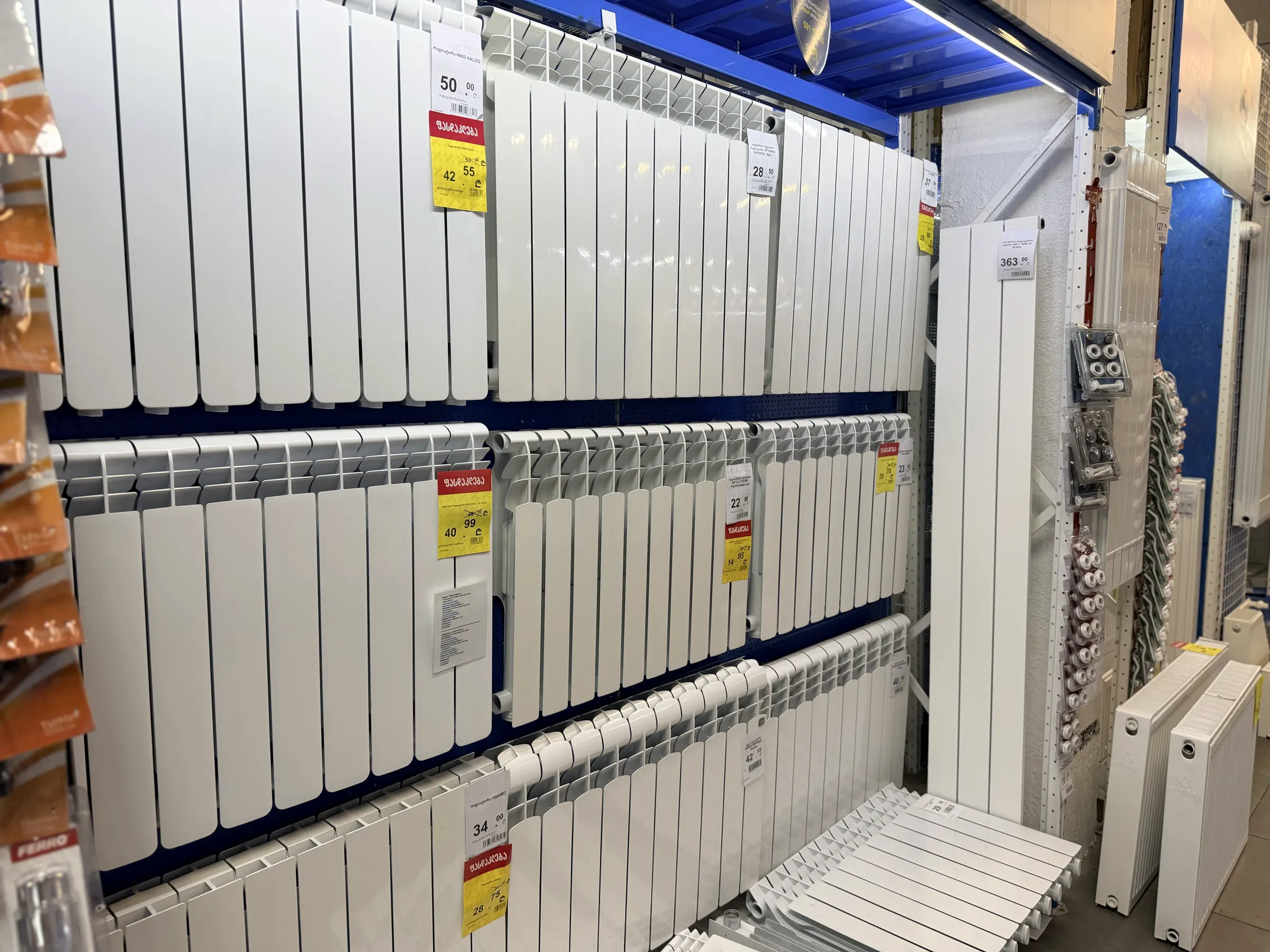

The goal of an energy-efficient renovation in Batumi isn't to keep heat in winter — it's to control humidity year-round and reduce the load on the air conditioner in summer. This isn't Siberia, the climate is different. So the priorities flip: first windows, insulation, vapour barrier and ventilation, and only then heating. The kit is a double-chamber argon-filled glazing unit, XPS and Penofol from the inside with a vapour barrier, underfloor heating throughout the apartment, a Balu dehumidifier in spring, and a supply-and-exhaust unit with heat recovery. Below — what and why, at the level of the decisions our crew applies in Batumi apartments.
HVAC and the Batumi climate
What HVAC is and why it matters for Batumi
HVAC is heating, ventilation and air conditioning. Don't fixate on the term, fixate on the fact that in Batumi, all of this is primarily about humidity. The northern logic is "how to heat and not let the heat out." In Batumi, winter is mild, but high humidity stalks the owners almost all year: damp and rain in spring, stuffy maritime air in summer, rain again in autumn.
So an energy-efficient renovation in Batumi is a set of measures that:
- don't let humid air into the apartment, or let it in to be dried in a controlled way;
- reduce heat gains in summer and cut air-conditioner running hours;
- don't let moisture condense on cold surfaces — walls, reveals, ducts;
- and only as a last priority hold heat in winter.
In this logic, the choice of materials is obvious: windows with a double glazing unit, insulation from the inside, ventilation with heat recovery, and additionally a dehumidifier.
Seasonal energy spending in Batumi
Spending across the seasons is uneven, and not in the way someone from a continental climate is used to. Each season has its own main consumer.
| Season | Main consumer |
|---|---|
| Summer | Air conditioner + boiler for hot water |
| Winter | Underfloor heating / heating |
| Spring | Air drying (dehumidifier) |
Three seasons out of four you're working with the air: cooling and dehumidifying with the air conditioner (summer), drying with the dehumidifier (spring), or warming and slightly drying with underfloor heating (winter). Only autumn is conditionally "transitional," but even there you often need both a dehumidifier and periodic heating.
The conclusion: energy efficiency in Batumi is primarily about saving on cooling and dehumidification, not on heating. Every decision is judged on two questions: "how does this reduce the load on the air conditioner in summer?" and "how does this reduce the amount of moisture I'll have to fight later?"
Climate control by season
Spring — dehumidifier season
In spring in Batumi it's no longer cold, but it's super humid and rainy. You can walk around in a t-shirt, but the shoes and clothes in the wardrobe start to "bloom" from damp, and droplets appear on cold walls and reveals. You don't want to switch on the air conditioner: it's not hot outside, and cooling for the sake of dehumidification works poorly. And no, the AC alone isn't enough.
In our experience, the best solution is a good dehumidifier. In Georgia, many Balu models are sold — that's an adequate mass-market option for an apartment. A few practical points:
- Size the dehumidifier for the room area, with a margin, not just enough.
- The dehumidifier doesn't have to stand as a separate "box" in the living room. It can be built into furniture — into a wardrobe niche or a special module. That's better aesthetically, quieter, and the grilles can be vented to the right zones.
- The air conditioner can also dehumidify (dry mode), but in electricity terms it's slightly more expensive than a dedicated dehumidifier: the compressor runs "excessively powerful." For permanent residence, a dedicated dehumidifier pays back in convenience and in the off-season bill.
The main point: in spring, the dehumidifier takes off the air conditioner's unnecessary load and holds normal humidity even with windows open after rain. People often forget to plan for this item, but in a Batumi apartment it matters more than an additional heater.
Summer — air conditioner for everything
In summer, the main consumer is the air conditioner. In Batumi apartments this is enough: one well-sized split system holds both temperature and humidity. Modern inverter splits run for a long time at medium power and incidentally dehumidify the air. Not as accurately as a dehumidifier, but in heat the task is different, and dehumidification comes as a "bonus."
So in summer the dedicated dehumidifier is often switched off — the AC takes both functions. But precisely because of the double load, it's important not to let it work "in vain": don't let heat and humid air from the street into the apartment. That's the job of the windows, insulation and ventilation with heat recovery.
Any decision that reduces heat gains in summer (a double-chamber glazing unit, XPS on the walls, insulated reveals, a heat-recovery supply unit) translates directly into hours and kilowatts that your AC isn't running. That's the main energy saving in Batumi.
Winter — underfloor heating instead of radiators
If the project includes underfloor heating throughout the apartment, don't add radiators. That's a common mistake: people are afraid the underfloor "won't be enough" and put in both the floor and radiators under the windows. In the Batumi climate that's overkill — temperatures here very rarely drop below zero.
Underfloor heating throughout the apartment heats the room more evenly. The heat goes from below upward across the whole area, there's no "hot at the radiator, cold in the corner" gradient, no convection currents kicking dust around. Subjectively it's more comfortable than radiators: feet warm, head cool.
In Batumi, underfloor heating isn't a luxury — it's a working tool. Winters here are mild, but humid and windy off the sea. Radiators dry the air locally around themselves and leave the floor cold; underfloor heating slightly dries the entire area and stops cold surfaces from picking up moisture. That dovetails with the main task on humidity.
An important nuance: underfloor heating is laid in from the start, at the rough renovation stage, under the right type of final flooring. It doesn't combine well with "let's add it later" — redoing the screed in an inhabited apartment is expensive and dirty.
Insulation from the inside
XPS or Penofol
Insulation in Batumi solves two tasks at once: in winter it holds heat, in summer it doesn't let heat in from the heated facade. The second is more important in this climate.
Most Batumi new builds are 200 mm monolithic concrete without insulation. The concrete wall is in direct contact with the street: in summer it heats in the sun and gives heat back inside, in winter it cools and pulls heat outward. On such a wall, it's easy to get a dew point on the room side, then condensation and eventually mould.
External insulation in new builds is restricted: the facade is shared, building-wide, and getting external installation approved is practically impossible. So we insulate from the inside, with two working options:
- XPS, extruded polystyrene foam. Rigid boards, low water absorption, good thermal insulation. The main layer on the wall.
- Penofol, foil-faced material, thin. Works where you can't put a thick layer: window reveals, narrow wall sections, cold ducts.
In our experience these materials often go together: XPS as the main layer, Penofol where you need it thin and the reflective foil matters. Under plaster or drywall, the system hides neatly and doesn't eat much usable area.
An important point: with insulation from the inside, a proper vapour barrier is mandatory. Otherwise insulation turns into a problem — I've described it in detail below.
Dew point and vapour barrier
This is the key technical point on which DIY renovations come apart.
The dew point is the temperature at which water vapour turns into condensate. The higher the humidity, the higher the temperature at which the air starts "weeping." In a Batumi apartment humidity is high almost always, so condensation forms on a cold surface easily.
With external insulation, the entire "cold" zone is the insulation and the facade — the load-bearing wall is in the warm, the dew point is outside. With internal insulation (and in Batumi this is more often a forced choice), the picture changes: the load-bearing wall stays cold, and the warm air from the room tries to reach it through the insulation. If humid air freely passes through the insulation, the dew point ends up inside the insulation or on the insulation/concrete boundary. Condensate will form there, and from there comes damp, material breakdown, mould.
To prevent that, with insulation from the inside, a vapour barrier on the room side is mandatory: a continuous, hermetic film between the insulation and the final finish. All seams are taped, the film extends onto the floor, ceiling, window reveals and wraps around the perimeter.
The principle is simple: in the system "insulation inside the wall," vapour permeability rises from the room toward the street. From the room side, hermetic (vapour barrier). From the street side, we don't intervene — concrete itself is sufficiently "closed," and there'll be no condensate in the insulation, no humid air will reach inside.
If you skip this step, no amount of XPS or Penofol will save you. In a year or two, mould will grow under the pretty finish.
Windows and reveals
Windows as the main heat-loss channel
Heat losses in an apartment most often go through the windows. Even in an insulated apartment, the window remains the "coldest" and "hottest" surface. In Batumi this is critical in both directions: in winter heat leaves through the glazing unit, in summer solar energy enters.
The main problem of almost all new-build owners in Batumi: developers install single-chamber glazing units to save a bit of money — two panes and one cavity. For the local climate that's not enough: holds heat poorly in winter, resists heat poorly in summer, and in shoulder season actively gathers condensation on the room side.
Replace single-chamber with double-chamber argon-filled
The minimum for an energy-efficient renovation is a double-chamber glazing unit: three panes, two cavities. Preferably argon-filled instead of regular air: argon is heavier, conducts heat worse, and the same glazing unit performs noticeably more efficiently with it.
A double-chamber argon-filled glazing unit:
- holds heat better in winter, reduces underfloor-heating costs;
- lets less heat through in summer, the AC works under less load;
- "weeps" less in shoulder season, the inner pane is warmer, condensation appears less often.
This is the most obvious and most felt-in-effect replacement in an energy-efficient renovation.
Profiles: Rehau, KBE, Veka — all three made in Batumi
The second parameter is the window profile. Reference: minimum 5-chamber. "Chambers" are internal air cavities that work as thermal insulation of the frame itself. The more there are, the better the profile holds heat and sound.
By brand in Batumi it makes sense to look at Rehau, KBE, Veka. All three are well-known systems, and all three are produced directly in Batumi. The windows don't need to be brought from Turkey or Tbilisi, lead times are shorter, and on warranty it's easier to deal locally.
The specific choice is a question of project, profile section, budget and availability in the right colour. All three, with the right configuration (double-chamber argon-filled glazing unit, minimum 5-chamber profile), give a result sufficient for an energy-efficient renovation in Batumi.
Correct window installation
The window itself is only half the story. The second half is how it's installed in the opening. You can buy an expensive system with a double-chamber argon-filled unit and lose the entire effect on bad installation.
A correct seam between the window and the wall is built like this:
- Outside, vapour-permeable tape: lets water vapour out, but doesn't let rain water in. The seam "breathes" in the right direction.
- Inside, vapour-barrier tape: hermetically blocks humid air from the apartment getting into the installation seam.
- Between them, foam: holds the window in the opening and works as seam insulation.
The main no-no is exposed foam. Without the tapes, it absorbs moisture from the apartment and the street, breaks down under UV, and condensation and draughts appear in the seam. In a year or two, such a seam turns into a thermal bridge and a source of mould around the perimeter of the window. From the side it often looks like "the window is sweating," but the problem is in the installation.
When ordering windows, specify installation by the "warm contour" method: vapour-permeable tape outside, vapour barrier inside, no exposed foam. On the windowsill and reveals, that same tape continues — no gaps and no breaks.
Reveals: thin XPS or Penofol
The reveals — narrow strips of wall around the window — by default remain a "cold bridge." The concrete around the window is thin, only a few centimetres of frame separate it from the glazing unit, and in winter this section freezes first. So condensation most often appears around the perimeter of the window, even if the glazing unit is good.
The solution is simple — insulate the reveals. A thin layer of Penofol or XPS under the final finish removes the cold bridges and the condensation. A large layer isn't needed: 10–20 mm is enough; the main thing is for the layer to be continuous and to reach onto the frame.
The logic is the same as with the wall: the cold concrete of the reveal is separated by thin insulation from the warm room, on top goes a vapour barrier and the final finish, the seams are taped to the installation seam tape. Around the window, you get a continuous hermetic contour.
After this work, the reveals stop "sweating," and the apartment loses one of the most popular spots for mould.
Ventilation
An energy-efficient renovation isn't only about "holding heat and not letting heat in." It's also about air. If you hermetically seal the apartment with quality windows and insulate it from the inside, without ventilation it quickly becomes stuffy and humid, and condensation will appear on the insulated surfaces. Without ventilation, all the work turns against itself.
Our crew designs ventilation in Batumi at the same time as insulation. Minimum — provide exhaust. Optimum — a supply-and-exhaust system with heat recovery.
Minimum — exhaust in bathrooms and the kitchen
The minimum is a powered exhaust fan in every bathroom and in the kitchen. Natural draft in modern monolithic buildings often isn't enough, especially in shoulder season and with micro-ventilation. Powered exhaust removes moisture and odours straight from the source and creates a slight negative pressure that pulls fresh air in from the living rooms.
Fans are sized by room volume. A simple formula:
- room volume (length × width × height, in m³) × air-exchange rate of 8–10 times per hour;
- the resulting number is the minimum fan capacity in m³/h.
For example, a bathroom of 2×2×2.7 m is about 10.8 m³, and the exhaust should be in the range of 90–110 m³/h. For the kitchen — more: it's larger, and the rate is the same. The estimate gives a model fitting the room, not "any old fan."
The exhaust should switch on with the light switch, on a timer or a humidity sensor, especially in the bathroom and shower room. In the Batumi climate it's better to overdo it on exhaust than to underdo it.
Optimum — supply-and-exhaust unit with heat recovery
If budget and project allow, the optimum is a supply-and-exhaust unit with heat recovery. A full HVAC node: it simultaneously brings in fresh air from the street and takes spent air out, and inside the unit the streams exchange heat and moisture through a heat exchanger without mixing.
What this gives in the local climate:
- in summer, the unit doesn't pump the humid street air directly inside. It passes through the heat exchanger, gives up part of its temperature and moisture to the outgoing air, and what reaches the room is a noticeably drier and cooler stream. That removes a huge load from the AC: it doesn't need to additionally cool and dehumidify "fresh from the heat" air;
- in winter the picture is mirrored: the heat-recovery unit warms the incoming street air at the expense of the outgoing warm air. The apartment's heat is reused, the underfloor heating works more gently and more rarely goes to maximum.
Additionally, a heat-recovery unit gives continuous air filtration: dust, pollen and sea aerosol don't reach the apartment. Especially valuable in Batumi with the sea right next door.
From the renovation point of view, a supply-and-exhaust system is something you design before the ceiling finishing: it requires duct routing. Adding it after the renovation is painful, so the decision is made at the very start.
Duct insulation
A separate point that's often missed: ducts must be insulated. Honestly, in our experience this is the place most often forgotten. In the Batumi climate, condensate falls on cold ducts — the same physics as on cold walls, only the surface is hidden behind the ceiling.
Without insulation, the exhaust duct carries warm humid air outside, and in the cold time of year the wall cools: condensate gathers on the outer surface (inside the ceiling), drops drip down, yellow stains appear. A supply duct in heat, conversely, carries cooled air, and outside it the warm humid air of the ceiling space condenses.
The solution is to wrap all ducts in a layer of thermal insulation. Often the same Penofol with the foil side works, or specialised ventilation sleeves. The main thing: not a single metal or plastic duct in a suspended ceiling should run "naked."
This work isn't visible after the renovation. But it determines whether or not a stain will appear on the ceiling a year later. Our Level Up crew puts duct insulation in from the start: it's cheaper than the redo.
FAQ
Takeaways
- The goal in Batumi is humidity control and reducing the load on the AC, not heat retention.
- Seasons: summer — air conditioner, winter — underfloor heating, spring — Balu dehumidifier.
- Windows: double-chamber argon-filled glazing unit, 5-chamber profile, Rehau/KBE/Veka.
- Installation by the "warm contour" method; reveals — thin XPS or Penofol under the finish.
- Insulation from the inside (XPS + Penofol) with a mandatory vapour barrier.
- Underfloor heating throughout the apartment, no radiators.
- Ventilation: minimum — exhaust by the formula volume × 8–10 changes/hour; optimum — supply-and-exhaust with heat recovery.
- Ducts must be insulated.